Sketches of public leaders I know or have watched closely.
NOTE: “THE OBAMA CHRONICLES” ARE BELOW THESE OTHERS AND CAN BE READ RIGHT HERE ON SCREEN.
Rupert Murdoch vs. the Republic, TPMCafe, 2007
George W. Bush and the ‘Bad Boy’ Vote, Los Angeles Times, 2004
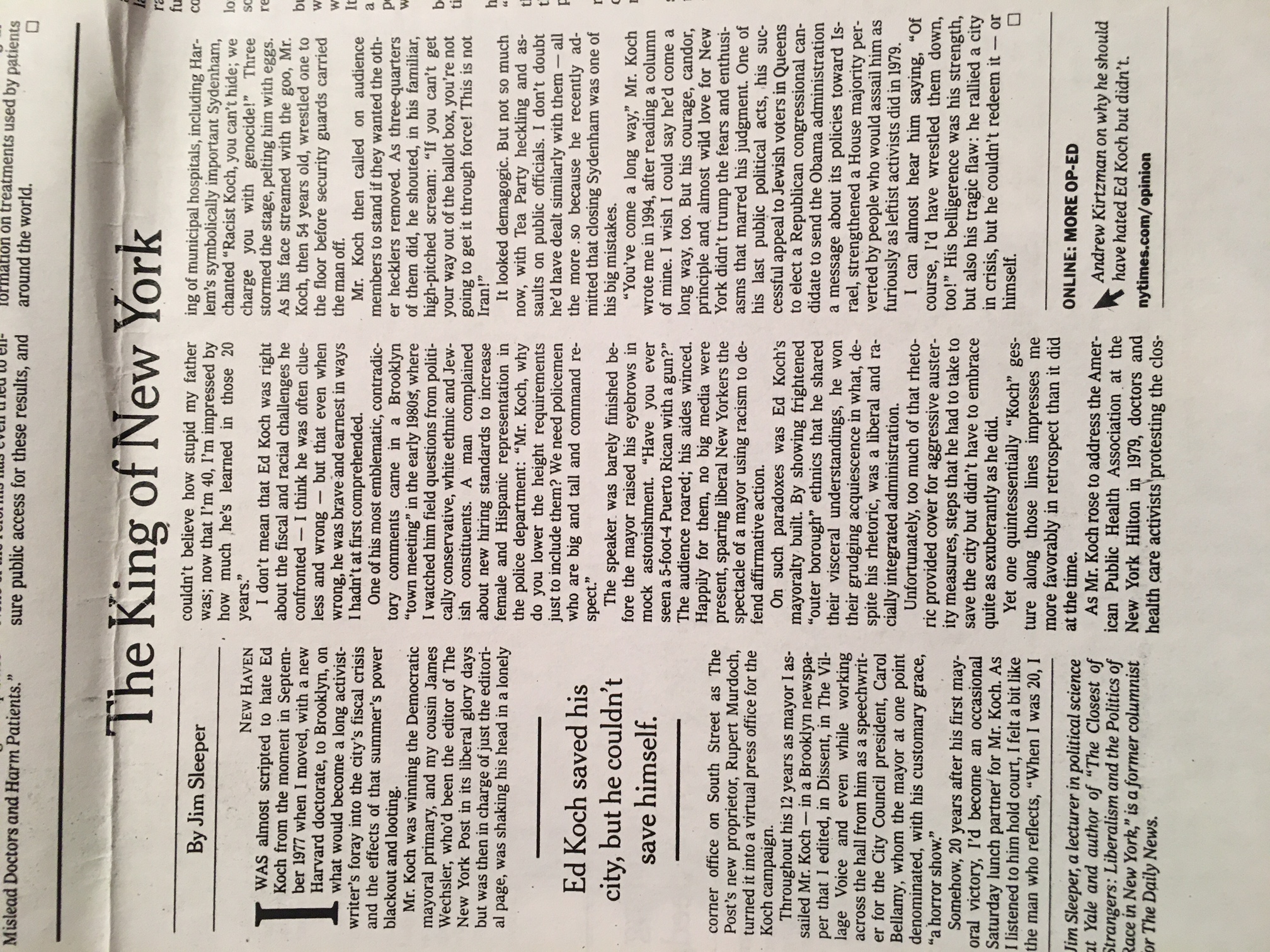
Ed Koch’s mouth and New York’s prospects, Dissent, 1981
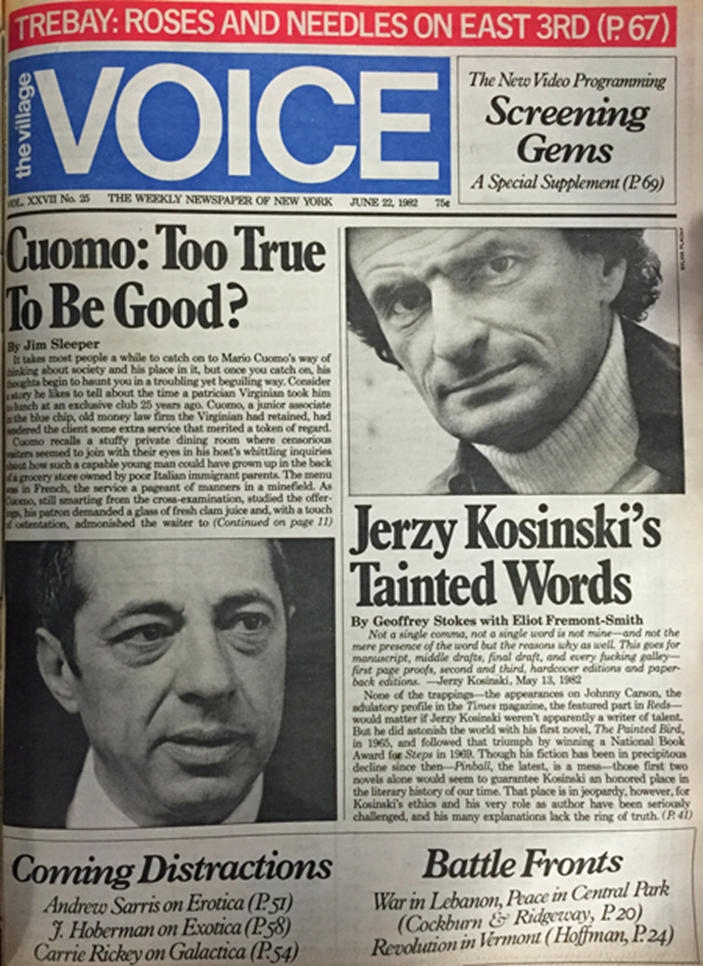
Wealthy warlords and hapless idealists,Village Voice, 1982
Al Shanker and New York liberalism’s travails, Democracy Journal, 2008
Jesse Jackson’s miscarried promise, Washington Post, 1992
New York’s Giuliani-Dinkins mayoral contest, 1993, Daily News columns Note the third column, on the Rev William Augustus Jones, a precursor of Obama’s Rev. Wright.
Giuliani just before 9/11, New York Observer, 2001
Chicago’s Harold Washington, larger than life, even in death, Washington Post, 1992
Al Sharpton’s struggle to pick up the pieces, The New Republic, 1991
Ronald Reagan’s sweet songs of civic republicanism, New Haven Review of Books, 2007
Bill Bradley’s near-miss, The New Republic, 2005
Training civic-repubican leaders at Yale, Los Angeles Times, 2004
A teen guru lures American youth out of “the Movement,” Boston Phoenix, 1973
Goodbye Larry Summers, Without Regrets, History News Network, 2006, and a look at Harvard College during his presidency.
A Literary Prophet’s Bad Faith: TPMCafe, April 28, 2008. This assessment of Leon Wieseltier’s assault on Martin Amis book about 9/11 in the New York Times Book Review shows not ony that it takes one to know one but also that envy and rivalry here are compounded by bad faith.
JIM SLEEPER’S OBAMA CHRONICLES
If you or anyone you know is writing a book or article or doing other work on the 2008 presidential campaign, please use or share these columns, posted from the morning after the New Hampshire primary of January 8, 2008 through Inauguration Day, January 20, 2009.
These columns, some widely linked and discussed at the time, trace the evolution of my and many other people’s thinking about Obama’s candidacy and his handling of charges involving race, elitism, exoticism, economic orientation, and leadership qualities, and style. Two of the columns take the measure of Rudy Giuliani and John McCain in ways I haven’t seen done elsewhere. Most were published at Talking Points Memo’s www.tpmcafe.com
The columns addressing racial politics include some assessments of what other commentators, from Shelby Steele (1 column) and Sean Wilentz (2 columns) to leftist critics of Obama (2), were saying about his handling of race. There are also columns on Farrakhan’s unwanted endorsement, the mixed legacy of Rev. Jeremiah Wright, Obama’s comment about whites who “cling to guns and God,” and Obama’s speech on race in Philadelphia.
Other titles suggest their contents: “Obama, Crowds, And Power”, “Obama: Neo-Liberal or Civic-Republican?” etc.
Also selected here are comments about these columns that were posted in the NY Times “Opinionator,” The Chronicle of Higher Education, by the neo-conservative Obama-basher Daniel Pipes, and more..
The collected columns are right here on screen, but you may also access them at http://www.jimsleeper.com/?p=11 and forward the url to others, with this introduction.
With best wishes, Jim Sleeper
_________________________________________________
http://www.tpmcafe.com/blog/coffeehouse/2008/jan/09/if_i_vote_for_obama_itll_be_because
Talking Points Memo Cafe
If I Vote for Obama, It’ll Be Because….
January 8, 2008
(the morning after the New Hampshire primary)
By Jim Sleeper
The preacherly cadences in Barack Obama’s “Yes We Can” speech last night in Nashua deepened his two greatest symbolic promises: Domestically, he makes being an American beautiful again because, in him, it makes achievable what is still incredible to many — a 400-year-old hope that we can untangle the race knot we’ve tied ourselves in since 1607. “It’s not something he’s doing,” Dartmouth Professor Joseph Bafumi told the New York Times; “it’s something he’s being.”
Internationally, therefore, Obama reminds multitudes of what has fascinated them about America – not just its wealth and power, which are trashy and brutal even when irresistible, but a folksy universalism that disposes Americans to say “Hi” to anyone rather than “Heil” to a leader, to give the other person a fair shot, and, out of that kind of strength, to take a shot at the moon.
Our wealth and power often subvert what’s best in us. But because Obama knows that human failings make this more complicated than either conservative moralism or leftist anti-capitalism alone can explain, his promise runs deeper than the poetry of campaigning. But can that promise really become the prose of governing? Can we take his symbolism for substance?
Obama says “Yes we can,” arguing that the movement his campaign is building will sustain him as president against countervailing powers. But a campaign isn’t a movement, and the 1960s taught that even a swelling movement is no substitute for the sustainable, organized power of a political party or coalition of parties, unions and churches that can mobilize disciplined multitudes again and again in support of a program.
Many have been elected who could not govern. At David Dinkins’ inauguration as New York City’s first black mayor in 1990, the audience teared up as the Rev. Gardner Taylor of Brooklyn’s Concord Baptist Church intoned, “God of our weary years, God of our silent tears.“ But people’s high sentiments foretold little about what they would get, which was a big let-down, and not mainly because racists crawled out of the sewers of Archie Bunker’s neighborhoods to elect Rudy Giuliani. That wasn’t why Giuliani defeated Dinkins in 1993.
Hillary Clinton’s tears in New Hampshire remind us that she, too, has endured and overcome a great deal and, like Obama, is “being” as well as “doing”. But she knows what governing actually entails, and it’s unfair to say, as some do, that she knows too much about it because of all the baggage she carries from her husband’s presidency.
Obama doesn’t yet know enough about governing to discredit Bill Clinton’s argument that electing him would be a roll of the dice. One might answer that JFK was a roll of the dice, too, but in consequence we got the Bay of Pigs and the Vietnam disaster. Kennedy and his brother Bobby had to learn civil rights on the job, something neither Barack nor Hillary will have to do, but face it, Barack’s learning curve is at least as steep as he is smart.
His really impressive personal struggle and the profound intuitions it has given him about public rights and wrongs are refreshing in a politician, much more so than anything was in candidate Jack Kennedy. And Obama’s American self-becoming has made him the catalyst of a campaign that, while it is not yet a movement and may never be a governing coalition, has nevertheless earned him a strong claim to Americans’ critical support.
His campaign confirms many Americans’ yearning to believe again that, unlike that of almost any other nation in history, the national identity of the United States was founded not on myths of primordial kinship, of “blood and soil,” but on a more universal experiment that enjoins all Americans, “by their conduct and example, to decide the important question, whether societies of men are really capable or not of establishing good government through reflection and choice, or whether they are forever destined to depend for their political constitutions on accident and force,” as Alexander Hamilton put it.
Claiming one’s identity as an American, therefore, means standing up personally as well as politically for this daunting civic-republican challenge, against exclusionary racial, religious, and other strains that have persisted alongside and within our republican framework.
That is what Rosa Parks did, and it is what Obama is doing — first by being what he has made of himself as a man, and second by running for president. And I must say, as one who has argued for years that Americans must let race go as an organizing principle of even progressive politics — because too much of even what passes for anti-racism only ends up recapitulating racism itself — I can’t help feeling that Barack is everything I’ve hoped an American could be.
But Hillary’s claim to be doing some of this American heavy lifting is deep and credible, too. If I vote for Obama, it won’t be because I discount Hillary Clinton’s symbolic and substantive leadership but because my yearning to get beyond race will be strong enough to impel me to try this roll of the dice.
I elaborated in response to one of the posted comments:
On January 9, 2008 - 11:11am ______ said:
Just a guess (Jim Sleeper will correct me if I’m way off), but the challenge he’s talking about is less Obama’s being black than the reaction and response from “the rest of us” to the participation and leadership that black folk can bring to our civic culture.
Jim Sleeper reply
On January 9, 2008 - 12:08pm Jim Sleeper said:
The challenge I think we’ll need to face down this year is the temptation to essentialize race – in which people think that having a skin color means having a “culture” because that’s what white supremacists and oppressed blacks made of racism, for obvious reasons, across 400 years.
The challenge is not only racism itself, in other words, but some of what often passes for anti-racism – the presentation of racial identity as somehow redemptive of personal and public justice.
This is a difficult argument to make well, because blacks, trapped in the race-box whites have kept them in, generally have had no option but to embellish and deepen a protective black racial identity, in ways that are sometimes perverse.
But there is another side of the story. Precisely because most African-Americans were abducted and plunged wholesale into the American experience at no initiative of their own and with scant material or cultural resources to fall back on, they have had the greatest possible stakes in the American republic’s living up to its stated creed. Blacks have been among the most eloquent champions of the republic’s promises but also among the most nihilist of its assailants, for obvious reasons.
I argue in “The Closest of Strangers: Liberalism and the Politics of Race in New York (Norton, 1990)and in “Liberal Racism” (Rowman & Littlefield,2002)that the long struggle of countless blacks to join and champion the republic is “the most powerful epic of unrequited love in the history of the world.” Moreover, even if every broken heart could be mended and every theft of property and opportunity redressed, still there would be a black cultural community based on the memories and virtues of survival in adversity.
But that’s not the same thing as saying that having a color should automatically mean having a culture. That’s reductionist and, at a certain point, it depletes individual dignity more than it enhances it. We all — blacks, whites, including white racists and white liberals who dote on race — have to get over the hump of denying that race should and will recede in importance to the point that it carries no more power in determining your prospects than, say, a difference in eye color among whites.
But to get over that hump of denial about race, we will need transitional figures like Obama, who both embodies and has worked his way through what I am talking about. In Bakke, Justice Harry Blackmun wrote that before we can hope to get beyond race, we must first take more account of it, not less. The question is what we mean by “first” — how long and in what ways. Obama strikes that balance perfectly, at least as a campaigner. He is faithful to the collective cultural memory without making it determinative of his and others’ prospects.
I should probably add that I wrote the two books just mentioned after ten years’ immersion in inner-city black life and politics, in Brooklyn. I sketch this in the introduction to The Closest of Strangers. That book and Liberal Racism are available from Amazon, etc, and in libraries.
The following was one of the most widely linked during the campaign.
http://www.tpmcafe.com/blog/specialguests/2007/mar/08/why_rudy_giuliani_really_shouldn_t_be_president
March 8, 2007
Why Rudy Giuliani Really Shouldn’t Be President
By Jim Sleeper
The deluge of commentary on Rudolph Giuliani’s presidential prospects has forced me finally to break my long silence about the man. Somebody’s gotta say it: He shouldn’t be president, not because he’s too “liberal” or “conservative,” or because his positions on social issues have been heterodox, or because he seems tone-deaf on race, or because his family life has been messy, or because he’s sometimes been as crass an opportunist as almost every other politician of note. Rudy Giuliani shouldn’t be president for reasons more profoundly troubling. Maybe you had to be with him at the start of his electoral career to see them clearly.
Throughout the fall, 1993 New York mayoral campaigns, I tried harder than any other columnist I know of to convince left-liberal friends and everyone else that Giuliani would win and probably should. In the Daily News, the New Republic, and on cable and network TV, I insisted it had come to this because racial “Rainbow” and welfare-state politics were imploding nationwide, not just in New York and not only thanks to racists, Ronald Reagan, or robber barons. One didn’t have to share all of Giuliani’s “colorblind,” “law-and-order,” and free-market presumptions to want big shifts in liberal Democratic paradigms and to see that some of those shifts would require a political battering ram, not a scalpel.
I spent a lot of time with Giuliani during the 1993 campaign and his first year in City Hall, and while a dozen of my columns criticized him sharply for presuming far too much, I defended most of his record to the end of his tenure, and still would. He forced New York, that great capital of “root cause” explanations for every social problem, to get real about remedies that work, at least for now, in the world as we know it. Some of these turned out to be preconditions for progress of any kind. I saw Al Sharpton blink as I told him in a debate that twice as many New Yorkers had been felled by police bullets during David Dinkins’ four-year mayoralty as during Giuliani’s then-seven years and that the drop in all murders meant that at least two thousand black and Hispanic New Yorkers who’d have been dead were up and walking around.
Giuliani’s successes ranged well beyond crime reduction. As late as July, 2001, when his personal and political blunders had eclipsed those gains and he had only a lame duck’s six months to go, I insisted in a New York Observer column that he’d facilitated housing, entrepreneurial, and employment gains for people whose loudest-mouthed advocates called him a racist reactionary. James Chapin, the late democratic socialist savant, considered Giuliani a “progressive conservative” like Teddy Roosevelt, who was a New York police commissioner before becoming Vice President and President.
Yet Giuliani’s methods and motives suggest he couldn’t carry his skills and experience to the White House without damaging this country. Two problems run than deeper current “horse race” liabilities such as his social views and family history.
The first serious problem is structural and political: A man who fought the inherent limits of his mayoral office as fanatically as Giuliani would construe presidential prerogatives so broadly he’d make George Bush’s notions of “unitary” executive power seem soft.
Even in the 1980s, as an assistant attorney general in the Reagan Justice Department and U.S. Attorney in New York, Giuliani was imperious and overreaching. He “perp-walked” Wall Streeters right out of their offices in dramatic prosecutions that failed. He made the troubled daughter of a state judge, Hortense Gabel, testify against her mother and former Miss America Bess Meyerson in a failed prosecution charging, among other things, that Meyerson had hired the judge’s daughter to bribe her into helping “expedite” a messy divorce case. The jury was so put off by Giuliani’s tactics that it acquitted all concerned, as the Washington Post’s Ruth Marcus recalled ten years later in assessing Special Prosecutor Kenneth Starr’s subpoena of Monica Lewinsky’s mother to testify against her daughter.
At least, as U.S. Attorney, Giuliani served at the pleasure of the President and had to defer to federal judges. Were he the President, U.S. Attorneys would serve at his pleasure — a dangerous arrangement in the wrong hands, we’ve learned — and he’d pick the judges to whom prosecutors defer.
As mayor, Giuliani fielded his closest aides like a fast and sometimes brutal hockey team, micro-managing and bludgeoning city agencies and even agencies that weren’t his, like the Metropolitan Transportation Authority and Board of Education. They deserved it richly enough to make his bravado thrilling to many of us, but it wasn’t very productive. And while this Savonarola disdained even would-be allies in other branches of government, he wasn’t above cutting indefensible deals with crony contractors and pandering shamelessly to some Hispanics, neo-conservative and orthodox Jews, and other favored constituencies.
Even the credit he claimed for transportation, housing and safety improvements belongs partly and sometimes wholly to predecessors’ decisions and to economic good luck: As he left office the New York Times noted that on his first day as mayor in 1994, the Dow Jones had stood at 3754.09, while on his last day, Dec. 31, 2001, it opened at 10,136.99: “For most of his tenure, the city’s treasury gushed with revenues generated by Wall Street.” Dinkins had had to struggle through the after-effects the huge crash of 1987.
Remarkable though Giuliani’s mayoral record remains, it’s complicated by more than these socio-economic circumstances and structural constraints. Ironically, it was his most heroic moments as mayor that spotlighted his deepest presidential liability. Fred Siegel, author of the Giuliani-touting Prince of the City, posed the problem recently when he wondered why, after Giuliani’s 1997 mayoral reelection, with the city buoyed by its new safety and economic success, he wasn’t “able to turn his Churchillian political personality down a few notches.”
I’ll tell you why: Giuliani’s 9/11 performance was sublime for the unnerving reason that he’d been rehearsing for it all his adult life and remained trapped in that stage role. When his oldest friend and deputy mayor Peter Powers told me in 1994 that 16-year-old Rudy had started an opera club at Bishop Loughlin High School in Brooklyn, I didn’t have to connect too many of the dots I was seeing to notice that Giuliani at times acted like an opera fanatic who’s living in a libretto as much as in the real world.
In private, Giuliani can contemplate the human comedy with a Machiavellian prince’s supple wit. But when he walks on stage, he tenses up so much that even though he can strike credibly modulated, lawyerly poses, his efforts to lighten up seem labored. What really drove many of his actions as mayor was a zealot’s graceless division of everyone into friend or foe and his snarling, sometimes histrionic, vilifications of the foes. Those are operatic emotions, beneath the civic dignity of a great city and its chief magistrate.
I know a few New Yorkers who deserve the Rudy treatment, but only on 9/11 did the whole city become as operatic as the inside of Rudy’s mind. For once, New York re-arranged itself into a stage fit for, say, Rossini’s “Le Siege de Corinth” or some dark, nationalist epic by Verdi or Puccini that ends with bodies strewn all over and the tragic but noble hero grieving for his devastated people and, perhaps, foretelling a new dawn.
It’s unseemly to call New York’s 9/11 agonies “operatic,” but it was Giuliani who called the Metropolitan Opera only a few days after 9/11 and insisted its performances resume. At the start of one of one of them, the orchestra struck up a few familiar chords as the curtain rose on the entire Met cast, stage hands, administrators, secretaries, and custodians — and Rudolph Giuliani, bringing the capacity audience to its feet to sing “The Star Spangled Banner” with unprecedented ardor. All gave the mayor “an ovation worthy of Caruso,” as The New Yorker’s Alex Ross put it. A few days later, Giuliani proposed that his term be extended on an “emergency” basis beyond its lawful end on January 1, 2002. (It wasn’t, and the city did as well as it could have, anyway.)
Should this country suffer another devastating attack before the 2008 primaries are over, Giuliani’s presidential prospects may soar beyond recalling. But the very Constitutional notion of recall could soar away with them. Even a stopped clock is right twice a day, and Giuliani was right for his time on a stage with built-in limits. But we shouldn’t have to make him the next President to learn why even a grateful Britain dumped Churchill in its first major election after V-E Day.
http://tpmcafe.talkingpointsmemo.com/2008/02/06/obamas_biggest_weakness/
Talking Points Memo Cafe
Obama’s Biggest Weakness
By Jim Sleeper
February 6, 2008
By far the most important warning I heard here at TPMCafe last night came from Ken Baer:
We need to take seriously that outside of those cutting very cool YouTube videos and packing unbelievably large rallies, there is a significant silent — at times — majority of working-class whites, Latinos, seniors, and women who like Hillary Clinton and will vote for her. For Obama, he has upscale whites and African-Americans…”
Obama must have been making that same observation while watching the returns, for his own exhortation of the night turned on a moving account of his early commitment, as a community organizer, to fight for low-income people. Yet precisely because it came from his personal experience on Chicago’s poor, black Southside, it underscored Ken’s caution about who Obama’s strongest constituencies are. Those of us who are old enough can remember that liberal Democrats have been here before, and paid dearly for it.
Yes, he carried other constituencies in states like North Dakota, Alaska, and Kansas that have few upscale whites and African-Americans. But Democrats won’t carry those states in November, and Obama is in trouble if - and I’m not yet sure about this — too many of his famously small $20 and $30 contributions come not from the people of the lower-middle and working classes whom Ken mentioned but mainly from people like the up-and-coming young white writers and journalists with whom I watched one of the recent Democratic debates from the tony (but not too tony) New York neighborhood of Brooklyn Heights.
Every time John Edwards mentioned broken workers in mills he’d known, the young crowd watching the debate hooted derisively, “The mill!, The mill!” Every time Hillary Clinton mentioned her 35 years of experience, they hooted, too. Sure, the candidates’ mantras had become tiresome. But the hooting got so annoying, too, that finally I quipped, “Don’t you have to be at least 35 years old before you can make fun of 35 years of experience?” I bit my tongue rather than ask if anyone present had ever been to a mill.
Like other fence sitters here at TPM, I finally decided to vote for Obama, for reasons I’ve explained here. And I still support him. But I do it with reservations I explained here, too.
I fear that too many young whites with bright prospects have no really serious intention of redressing the growing inequities which the neoliberal world that employs them is spawning, not just between themselves and poor blacks on the Southside but, these days, between blacks and blacks, and women and women, let alone between cool young whites like themselves and the declasse, lumpy white and Latino workers all around them.
Not that my young friends defend wholeheartedly the system in which they’re prospering. To their credit, it makes them uncomfortable. But they grasp at mostly symbolic gestures of a politics of moral posturing that relieves racial and class guilt and steadies their moral self-regard with smallish contributions to Obama, an Ivy alum whom they trust to help those people on the Southside without dragging them too deeply into it; without reconfiguring how we charter our corporations and re-construe the private and public investments that employ upscale young whites and well-behaved non-whites; and certainly without redistributing their own bright prospects and future prerogatives and second homes.
Some of the people I watched the debate with are too young to imagine themselves even wanting second homes. Yet redistributing their prospects and more is no small part of what we’d have to do in the coming world economy if any Democrat,– including Hillary Clinton — ever did win an election with a coalition of the long-dismissed and misdirected constituencies Ken reminded us about.
Unlike some of his supporters, Obama took his Columbia College humanities courses seriously enough to go down and out in Chicago before Harvard Law School and to wrest a fine book from his entrails. Even more important, he felt and thought his way through and out of a lot of racial displacements and deceits, with a personal and public courage most of us whites can admire but will never be called upon to emulate and demonstrate as he has.
Those are reasons enough to support him, and I do. But they are not reasons to have hooted at John Edwards or even, heaven help her, at Hillary Clinton.
http://tpmcafe.talkingpointsmemo.com/2008/02/13/obama_crowds_and_power/#more
Obama, Crowds, and Power
By Jim Sleeper
February 13, 2008
(just after the “Potomac Primaries”)
As a political movement gathers what seems to be irresistible force, it rides currents of anger as well as affirmation. How it balances and channels those currents determines its fate. A movement can be fired up by outraged decency, but it will come to little — or worse — if its participants spend more time and energy venting the outrage than advancing the decency.
Barack Obama understands this unusually well. But how will he help his supporters understand it, when the going gets tough? Answering that question requires knowing a little history, knowing Obama, and knowing ourselves, whether we are his supporters or not.
Outraged Germans had legitimate grievances in the early 1930s, but those grievances were rebuffed by the powers of the time, then stoked and perverted by a movement that became irresistible but was doomed because it subordinated its affirmations to its fears and rage.
Outraged African-Americans had pent-up grievances then, too. But in the 1950s and early 60s the civil-rights movement did not subordinate its affirmations to its rage. When Rosa Parks refused to move to the back of the bus in Montgomery and young men in clean shirts sought service at a lunch counter in Greenville, they did so with the disciplined dignity of citizens lifting up American civil society, not trashing it as inherently racist and damned. Their movement became irresistible, but because it emphasized positive liberty, it also endured against fierce crosscurrents and undertows that emerged against and even within it.
In the late 1960s, in another movement, outraged young Americans of all races had legitimate grievances against the Vietnam War, and many of us petitioned for redress of those grievances at first with a kind of innocent nobility that perhaps only young white Americans of the time could expect to sustain. But our movement imploded when some among us forgot the activist Norman Thomas’ admonition not to burn the American flag but to wash it and tried, instead, to “Bring the War home” against a republican spirit of trust that should have been our strongest defense against powers that were otherwise greater than ourselves.
Outraged pro-lifers, aggrieved by the violation of their belief that life is a sacred, intergenerational thread that must not be broken by individuals or states, sometimes practiced the dignified civil disobedience of the best anti-war and civil-rights activists. But some acted like the other movements’ most nihilist renegades, making demagoguery and murder seem more irresistible than faith and moral witness.
Finally, outraged Americans had compelling grievances against terrorism after 9/11, but our yearning to bond and be worthy of the courage we were witnessing in New York was swiftly misdirected against the wrong targets in an orchestrated storm of fear, intimidation and lies. This time, no anti-war movement destroyed the balance of anger and decency; it was the Iraq warmakers themselves, and their cheerleaders, who did that.
They made the war seem irresistible during the run-up to it late in 2002 and early in 2003. Yet Barack Obama resisted it, in part because he had good reason to know that it was doomed. He knew this, because he had let Rosa Parks and Norman Thomas teach him why and how to balance anger with disciplined love, something the pro-war movement wasn’t even trying to do. And his recognition of that bodes well for the political movement he is now trying to build.
That he still has some dark forebodings about what he is trying to build bodes well for it, too. The morning after the New Hampshire primary he warned supporters that harsh, underhanded attacks were coming. Two nights ago, on winning the Potomac primaries, he warned, “Change is hard” and sketched the odds against undoing the failed politics of recent years — the politics that protects CEOs’ bonuses rather than pensions, for example.
But Obama hasn’t said much about the inevitable temptations to self-congratulation and self-righteousness that also come with success, the almost irresistible seductions of power that accompany cascades of money and applause. Overcoming such temptations will test his faith and prowess and his supporters’ character in new ways.
The ancient historian Thucydides is often touted by the grand strategists who are destroying this republic in their misguided efforts to save it by stampeding Americans into wars and other mobilizations of a national-security state. But Thucydides cautioned Athenian democrats that
“The idea that fortune will be on one’s side plays as big a part as anything else in creating a mood of over-confidence for sometimes she does come unexpectedly to one’s aid, and so she tempts men to run risks for which they are inadequately prepared. And… each individual, when acting as part of a community, has the irrational opinion that his own powers are greater than in fact they are. In a word it is impossible… for human nature, when once seriously set upon a certain course, to be prevented from following that course by the force of law….”
That is the secret of any movement’s irresistible power, but also the secret of its great peril to its members’ and others’ dignity. It is no small point in Obama’s favor that he knows this secret and has declined to trade cynically on illusions of power in crowds: “Cynicism is a sad kind of wisdom,” he said, almost offhandedly, in his speech the other night. Would that fear-mongering neoconservatives were secure in themselves enough, and sophisticated enough, to understand that..Would that they could understand columns like Michael Tomasky’s beautiful “The Wisdom of Crowds,” just posted at The Guardian online
Now Obama will have to teach the secret of the dangers of collective power to his supporters, and they to one another. His movement needs teachers, mentors, and lieutenants who can strengthen it in a faith deep enough to transcend power’s illusions.
A movement’s and a republic’s power lies not only in its armies, lawyers, and wealth, indispensible though they are, but, ultimately, in the very vulnerability a republic sustains in a canny ethos of trust. That’s what people have managed to sustain in the successful movements that have gone before. If they can’t do it now, what seems irresistible in the movement of this moment will not endure, and what seems powerful in it will not leave its supporters free.
http://tpmcafe.talkingpointsmemo.com/2008/02/27/obama_in_a_valley_of_insinuati/index.php
Obama in a Valley of Insinuations and Lies
By Jim Sleeper
February 27, 2008, 7:01PM
I’ve spent a lot of time around serious scholarship and even more around real journalism– the kind that, in print or online, requires “leg work,” climbing tenement stairs the second time or making that last phone call or watching the expression on the campaign manager’s face as you pop your question. Sometimes there’s no substitute for going there to get the story, even if you think you’ve already figured it out or heard it all before.
Real scholars uphold equivalent standards, but in today’s New Republic, the Princeton historian Sean Wilentz shows us only the arrogance and opportunism of a man who’d hoped to be the Arthur Schlesinger, Jr. of a Hillary Clinton Administration. Here, he treats one of his forays into journalism as slumming to help his side and mess up Barack Obama’s effort by spinning charges that Wilentz doesn’t trouble to substantiate with interviews or research of his own.
Wilentz plunges Obama into a hall of mirrors and insinuations by stringing others’ reports to accuse him of accusing the Clintons of accusing him of calling them race-baiters. Got that? I get it, having written a lot about racial politics for The New Republic myself, not to mention for the New York Daily News, where I had many black readers.
I know how to expose charming black impresarios of the racial street theater and the college common-room put-downs that freeze white liberals in their seats. Even in supporting Obama, I’ve expressed reservations here in posts like “Obama’s Biggest Weakness” and “If I Vote For Obama, It’ll Be Because…” I’ve never disparaged Hillary Clinton, whom Wilentz thinks he is defending.
But I do recognize attitudinizing and pulling rank, academically or streetwise, when I see them, and I know that someone has gone off the deep end when he ends 5500 words of endless pirouetting with a pompous polemic like this:: “[T]here is a long history of candidates who are willing to inflame the most deadly passions in our national life in order to get elected. Sadly, that is what Barack Obama and his campaign gurus have been doing for months — with the aid of their media helpers on the news and op-ed pages…. They promise to continue to until they win the nomination, by any means necessary.”
That might be a stirring peroration to a series of devastating revelations, but most of what preceded it reads like this:
“His string of victories in caucuses and primaries… gave the Obama campaign undeniable momentum. But Obama and his strategists kept the race and race-baiter cards near the top of their campaign deck — and the news media continued to report on the contest (or decline to report Obama’s role as instigator) as if they had fallen in line.”
The evidence, please? it never came.
Wilentz claims repeatedly that the Clintons are unfailingly gracious and astute but that Obama and his minions spin the Clintons’ benign observations to stir black paranoia and stampede voters. But read Wilentz yourself and tell me if you find anything in it, anywhere, that’s more than a parody of Talmudic exegesis gone wrong, a tangle of arguments by assertion. Does Wilentz even want to meet the kinds of people who might actually pick his stuff up and run with it?
He accuses an always-unspecified “media” and “press corps” of falling into line with Obama’s “race-baiter card” strategy. I take second place to no one in scourging “the media,” but why are all of Wilentz’s own sources recycled from the same media and press accounts of what candidates or their spokesmen have already said? He tells us repeatedly that “the Obama campaign” did this or that. But who, exactly? He never says.
Wilentz has operated this way before. He doesn’t so much take positions as look over his shoulder in two or three directions before positioning himself as an arbiter of what is safe and appropriate just now for progressives to say.
Sometimes he lurches into histrionic poses, as when he instructed a congressional impeachment committee that “history will judge” them — a pronouncement sufficiently snooty to remind even from those who agreed with him that history will judge Sean Wilentz, too, for shifting burdens of his own responsibility onto others.
Obama is shrewd, and no doubt he’s not pure; but if Wilentz has something to show us, let him show it, not pass off his speculations as charges sanctioned by the judgment of history.
His attack on Obama is too clever by half to persuade anyone who isn’t already cheering Wilentz on. The piece reads as if written in an exciting evening of phrase-turning in Princeton after a nice, long chat with someone from the Clinton campaign. The result is embarrassing to Wilentz, embarrassing to the New Republic, and offensive to those of us who’ve staked our credibility on wresting truth from storms of racial intimidation, insinuations,and lies.
http://chronicle.com/blogs/footnoted/1762/obama-and-the-race-card
Comment on the above column in
THE CHRONICLE OF HIGHER EDUCATION
February 28, 2008
Princeton historian Sean Wilentz, who has been vociferous in his support of Hillary Clinton throughout the Democratic primary season, has caused quite a stir with his latest foray into the realm of presidential punditry. In an acerbic essay that appeared on the Web site of The New Republic, Wilentz charges the Obama campaign with cynically exploiting the issue of race by “deliberately, falsely, and successfully” portraying the Clinton campaign as “unscrupulous race-baiters.”
Wilentz continues: “A review of what actually happened shows that the charges that the Clintons played the ‘race card’ were not simply false; they were deliberately manufactured by the Obama camp and trumpeted by a credulous and/or compliant press corps in order to strip away her once formidable majority among black voters and to outrage affluent, college-educated white liberals as well as college students.”
Wilentz’s essay is brimming with other such sharply worded accusations. Not surprisingly, it has stirred a vigorous response. As of this writing the piece has generated 440 comments on The New Republic’s Web site. And Jim Sleeper, a lecturer in political science at Yale, has entered the fray, accusing Wilentz of writing a bitter rant fueled by his (maybe?) dashed hopes of being the Arthur Schlesinger, Jr. of a Hillary Clinton administration.
Wilentz’s piece “reads as if written in an exciting evening of phrase-turning in Princeton after a nice, long chat with someone from the Clinton campaign,” Sleeper writes. “The result is embarrassing to Wilentz, embarrassing to the New Republic, and offensive to those of us who’ve staked our credibility on wresting truth from storms of racial intimidation, insinuations, and lies.”
__________________________________________________
http://tpmcafe.talkingpointsmemo.com/2008/03/04/how_to_really_put_that_farrakh/
Has History Cancelled Farrakhan’s Endorsement?
March 4, 2008 (Just before the Texas and Ohio primaries)
By Jim Sleeper -
The gravely ill Louis Farrakhan’s endorsement of Barack “Hussein” Obama was so rightly buried in the avalanche of commentary anticipating the vote in Texas and Ohio that I’m speaking almost out of turn in educing one more reason why it was stupid to try to tie part of the Jewish community in knots over this story.
But I doubt we’ve seen the last of such efforts. Even though Hillary Clinton looked silly pushing Obama about the Farrakhan endorsement in the last debate, and even though John McCain may well not mention it himself, it’ll be back, in some form, as long as Obama remains a contender. The irony is that something about Farrakhan’s Million Man March of 1995 in Washington, DC. showed the folly of black vs. white race-card playing as nothing had before.
In 1995 hundreds of thousands of black men turned Farrakhan’s march into something he hadn’t intended or been known for. They left his Nation of Islam disoriented and on the defensive, where it has been ever since, especially since 9/11, for reasons even those who enjoy scaring themselves with bogeymen should have enough of what Jews call “sey-khel” (call it mental acuity) to understand.
The danger of Farrakhan was always that, abetted by our sensationalist media, he would shatter a taboo on public expressions of anti-Semitism even more vile and protean than the kind in the Nation of Islam’s loopy cosmology.
Yet there was also something “retro” about Farrakhan’s rants, redolent of the days when Jews had been classic urban intermediaries between elites and the black, inner-city poor. If you were black in Chicago, New York, and not a few other American cities in the 1950s and early ’60s, it was often Jewish shopkeepers, landlords, teachers, and social workers who decided whether you could get a job, credit at the store, an apartment, a passing grade in school, or even an acquittal.
Most such encounters weren’t unfriendly, as the late black Brooklyn newspaper editor Andrew Cooper told me years ago for my The Closest of Strangers. But they were bound to grate, and, even now, every so often, some aging urban black leaders like Farrakhan — or like the City College of New York Prof. Leonard Jeffries, who ranted in the 1990s about Jews running the slave trade — usher black listeners of a certain age back into a psychic landscape flickering with old, familiar demons.
The rest of the world seldom cares, and the Million Man March showed that most African-Americans don’t care much anymore, either. Sure, that weekend there was a televised hate fest of Malik Al Shabazz, Amiri Baraka, and other souls frozen in time, but they had to stage their implosion not at the march itself but, the night before, at a public high school to which they’d been shunted. The multitudes of black men who’d come on long bus rides to Washington never heard them.
At the march itself, Farrakhan delivered an anti-Semitism-free skein of non-sequiturs and Masonic-like numerological divinations so stupefying that, when cameras panned the crowd, it was obvious he’d lost his audience. They’d come to bond as fathers and sons, brothers and strangers, and to claim, with a quiet poignancy, the credit blacks deserve for having built and died for the grand marble monuments all about them in Washington.
Immediately after 9/11, Farrakhan gave the most patriotic speech of his life, and no wonder: Suddenly, ” an entity called “The Nation of Islam” wasn’t a cool place to be. American flags flew all over black neighborhoods, and, in a burst of American bonding across race and class, many blacks sought a kind of reprieve: For once, no one could blame blacks for what had gone wrong. If anything, the burden was shifted to Islamicists.
That reminded me of something a Jewish community relations representative told me in 1990 during an acrimonious, sometimes violent black boycott of two small Korean groceries in Brooklyn. Apologists for the boycott portrayed its ugly name-calling and intimidation as the understandable response of a black neighborhood to price-gouging outsiders. But the “neighborhood” was far less involved than a notorious crew of racial street-theater impresarios who roamed the city in those days staging passion plays of archetypal black suffering for their own extortionist and dubiously therapeutic purposes.
“Whaddya think?” I asked the Jewish community-relations man, a genial, rumpled peacemaker in his mid-50s who’d weathered many such storms over the years.
‘Oh, s’wonderful, s’wonderful,” he murmured.
“S’wonderful? Why?”
“Look, the merchants aren’t Jewish anymore, so they’re not taking potshots at us there. The mayor isn’t Jewish anymore, so they’re not taking potshots at us there. We can be like the Quakers now. We can mediate!”
Well, maybe not, and my interlocutor knew that very well. Yet he had a point: Times change, and so do horizons.
How much sey-khel should it take to see that if the day ever came when a man stood on the Capitol’s South Portico intoning, “I, Barack Hussein Obama do solemnly swear….,” it would be a victory for America’s promise that we need not stay trapped in our pasts, a promise whose fulfillment in this case would leave more than just Farrakhan’s Nation of Islam in the shadows?
Not everyone can or even should let go of the past. Yet only the same failed Americans who also worried that the Austrian-born Arnold Schwarzenegger was a Nazi could worry now that Obama is a danger just because a dying, perhaps even repentant Farrakhan glommed onto him near the end. And only people who are still too fearful to affirm what’s best in this country would believe them.
http://tpmcafe.talkingpointsmemo.com/2008/03/18/in_philadelphia_obamas_histori/
March 18, 2008, 2:52PM
In Philadelphia, Obama’s Historic Challenge
By Jim Sleeper
“The Speech of a Lifetime,” Charles Kaiser is calling Barack Obama’s address on race this morning over at RadarOnline, and I’m inclined to agree. But here’s why:
As a demonstration of grace under immense pressure, his performance in Philadelphia will be a classic study for orators. As an act of moral witness and prophecy for a trans-racial America, the speech was straightforward yet profound in an inimitably American idiom that few partisans and pundits, soused in stale pieties and rancid evasions, comprehend.
He’s gambling that most Americans will comprehend him anyway. Here’s hoping. Let me explain what I think Obama accomplished with a story I’m sure he’d appreciate, an experience I had 15 years ago with Brooklyn’s equivalent of Obama’s pastor and mentor, Jeremiah Wright.
In the fall of 1993, as Rudolph Giuliani was challenging New York City’s first African-American mayor, David Dinkins, Al Sharpton’s long-time pastor and mentor, the Rev. William Jones, was reported to have denounced the Giuliani campaign as “fascist.” What happened next anticipated much of what Obama is responding to now, and it shows how well he has responded.
There was no video of the Rev. Jones like the ones we have now of Obama’s long-time pastor and mentor, Rev. Jeremiah Wright. Accounts of Jones’ remarks were unclear and contradictory. That didn’t stop political operatives and pundits from heaving themselves and the city into convulsions over Jones, of course.
Even though I leaned toward Giuliani at the time, I held my tongue about Jones and went to see him.
I knew that Jones, a former president of the National Black Pastors’ Conference and the pastor of Bedford-Stuyvesant’s gothic Bethany Baptist Church, was a magisterially angry leader of blacks in their ‘50s — a cohort, sketched by Obama in his Philadelphia speech, that followed men like Obama’s Pastor Wright and sometimes the even angrier Louis Farrakhan or the City College of New York Prof. Leonard Jeffries. These were African-Americans of a certain age who’d come of age when northern cities’ racism was as rigid and enraging as their opportunities were bedazzling to recent arrivals from the South.
In Brooklyn, Jones had mentored not only Sharpton but the Rev. Johnny Ray Youngblood, a leader of much the same exemplary community organizing Obama later undertook in Chicago. Jones, a former colonel in the Army Engineers and the first black graduate of the University of Kentucky, might have been a Colin Powell had he been born two decades later. Instead he’d come to Bedford-Stuyvesant with a doctorate from Crozer Theological Seminary, in 1962, a complicated, formidable man.
So I waited one Sunday in 1993 as Jones pronounced the baptismal formula in stentorian tones, lowering infants into the water with strong arms, as his father had done before him in the Kentucky bluegrass country’s oldest black congregation.
I listened as he told his congregants, brooding high in his pulpit, “Anybody who portrays me as a purveyor of slurs doesn’t know me and is perverting grossly what I said. I have been the victim of the worst ethnic slurs all my life, and I know better, by experience and professional training, than to portray anybody as less than human. I am a free man in a free pulpit, proclaiming freedom’s story. The easiest way to upset people in power is to tell the truth.”
As we sat together later, I asked Jones why he’d said that Giuliani’s backers include “elements that can best be described as fascist.” “As I move about the city,” he replied, “I sense a deliberate distortion of reality to demonize Dinkins. It’s a storm-trooper mentality. You needn’t be Mussolini to have it. You can be a [radio talk-show host] Bob Grant. There are black fascists — Roy Innis,” a well-known New York conservative demagogue at the time.
Jones had written what Wright and many other blacks of their generation believe: that a true black Christian is a race man. “Though not a racist, the race man is the embodiment of racial pride and has absolute distaste for the system. He begs no favors from the establishment but demands justice for his people.”
Like Wright, Jones had joined at times with Jesse Jackson to pressure white businesses in black communities to hire blacks. But he wrote also of “an interim ethic of black asceticism,” in which blacks withdraw from white society psychologically and culturally to plumb their own history, arts, and religion, “a step in the movement from [being] property to pride to power.”
It’s easy to imagine how thinking like this can take wrong turns, and Obama cautioned in his speech that “The profound mistake of Reverend Wright’s sermons is not that he spoke about racism [but] that he spoke as if our society was static; as if no progress has been made.”
It’s a bit harder to understand why the purse-lipped, finger-wagging scolds we’ll be hearing from can’t acknowledge that men of offended dignity such as a Jones or a Wright might talk sometimes as if the racist world they knew in their formative years hadn’t changed — and that younger blacks like Obama might listen to them but move on.
It’s especially hard to understand why certain Jews — of all people – can’t acknowledge this and, in fact, actually emulate the worst of it by peddling or succumbing to fears of an anti-Semitic Obama that are far more fanciful than a black preacher’s fears of, say, a racist Republican leader or two.
The answer is that some Jews, rather like Jones and Wright, can’t get past memories of having been classic urban intermediaries between urban elites and the black poor. In New York and Chicago in the 1950s and early ‘60s, Jews often decided whether blacks could get credit at the store, a job, an apartment, a passing grade, an acquittal. But those Jews, too, were struggling and vulnerable; they were white folks whose skin blacks could get under, the first to take alarm at black rage.
No wonder that every so often, some Jews, no less than Wright, Farrakhan, Jeffries, or Jones, usher listeners of a certain age into a psychic landscape flickering with old, familiar demons. No wonder that neither side admits that Louis Farrakhan has been in eclipse since 9/11 made “The Nation of Islam” a difficult place to be, and, indeed, since 1995, when hundreds of thousands of black men turned his Million Man March into a poignant manifestation of hope unlike anything he’d intended or understood.
For those who can’t notice or acknowledge how times are changing, Obama was never more effective in Philadelphia than when he put partisan strategists and pundits on the spot by listing the ways they flash race cards on the pretense of responding to someone else’s having done it.
It’s one thing for a white writer on urban racial politics like me to criticize black demagoguery and to draw some distinctions in connection with a Jones, Leonard Jeffries, or Louis Farrakhan. It’s something else for a black man do that, as Obama did in Philadelphia on Monday. That he did it was historic, his observations towering above the nit-picking and rumor-mongering which the speech will prompt as surely as every true call for hope has always done.
Anticipating all this, Obama confronted his listeners with a choice:
“We can tackle race only as spectacle – as we did in the OJ trial – or in the wake of tragedy, as we did in the aftermath of Katrina - or as fodder for the nightly news. We can play Reverend Wright’s sermons on every channel, every day and talk about them from now until the election, and make the only question in this campaign whether or not the American people think that I somehow believe or sympathize with his most offensive words. We can pounce on some gaffe by a Hillary supporter as evidence that she’s playing the race card, or we can speculate on whether white men will all flock to John McCain in the general election regardless of his policies.
“We can do that.”
“Or….. we can come together and say, ‘Not this time.’ This time we want to talk about the crumbling schools that are stealing the future of black children and white children…. about how the lines in the Emergency Room are filled with whites and blacks and Hispanics who do not have health care… about the shuttered mills that once provided a decent life…. and the homes for sale that once belonged to Americans from every religion, every region, every walk of life. This time we want to talk about the fact that the real problem is not that someone who doesn’t look like you might take your job; it’s that the corporation you work for will ship it overseas for nothing more than a profit.”
These words were addressed in no small way to a lot of journalists I know. Let’s watch what they do. And let’s also start talking about them if they find choices like the one Obama offered so scary that they leap to scare the rest of us with a Bill Jones or a Jeremiah Wright instead.
_____________________________________________________________
http://tpmcafe.talkingpointsmemo.com/2008/04/01/obamas_racial_wisdom_vs_holdou/
April 1, 2008
Obama’s Racial Wisdom vs. Holdouts Left and Right
(Shelby Steele’s – and some leftists’ – campaign against Obama)
By Jim Sleeper -
In December, just before the presidential primary season, the conservative black writer Shelby Steele published A Bound Man: Why We Are Excited About Obama and Why He Can’t Win. The book proved instructive in ways he didn’t intend: It showed the dangers of trying to shoehorn recent developments into paradigms that may have illuminated circumstances of 15 years ago but obscure the real opportunities and challenges now before us.
Academics and some belletrists are especially prone to this danger, perhaps even more so if they’re on the left and have made their careers creating, promoting and defending certain paradigms in conference after conference, as the world rushes by. Yesterday’s liberation becomes tomorrow’s dead hand. Just look at what became of romantic “third worldism” that celebrated “people’s liberation movements” but found itself tongue-tied by 9/11 and has gone to Gaza to die.
And look at what’s become of some leftist wisdom about race in America, right alongside Steele’s wisdom about the left. I wrote a couple of books about all this long enough ago for them, too, to bear reassessing. I’ve done that recently on a new website, but the interesting and fruitful discussion here of Obama’s recent speech prompts me to add a few observations now.
Steele was right in the 1990s to note that many racial remedies promoted by anti-racist liberals – from cookie-cutter “diversity” in higher education to congressional districting along race lines – were exercises in what he called “iconography,” by which he meant feel-good symbolism over substantive gain.
Democratic justice in education and elections in a republic requires incredibly heavy lifting in early schooling and in voter registration. It does not gain from racial “rotten boroughs” (whose voter turnouts are notoriously low) or number-fudging in college admissions that embarrasses and thereby segregates too many of its intended beneficiaries.
Steele understood this. He noted that upscale white liberals who’ve done well in the corporate capitalist dispensation have no serious intention of tackling its deepening inequities; yet they can’t bring themselves to defend them very wholeheartedly, either. So they grasp at a politics of moral posturing and tokenism that makes them feel better but doesn’t curb inequities that, thanks partly to their dodging, now divide blacks from blacks as well as blacks from whites, and women from women as well as women from men.
As a conservative, Steele wasn’t going to do anything about these inequities besides urge blacks to burn the midnight oil and vote. Yet the more glaring these inequalities became, even in the 1980s and 1990s, the more that liberals and facile leftists – the latter ideologically inclined yet daunted by the challenges of class more than of race — cut class (as in “economic class”) to wave colorful banners of racial and sexual identity, thereby offering fat targets to tongue-clucking conservatives more partisan than Steele.
In gilded liberal precincts such as Michelle Obama’s undergraduate Princeton and Barack Obama’s ( and her) Harvard Law School one saw periodic revival meetings where everyone from freshmen to deans swooned gratefully under the rhetorical lash of some iconic black speaker who posed as a tribune for all blacks while tapping vast stores of liberal white guilt and good intentions.
Steele had these racial bargainers’ numbers. He showed how they put whites through rituals of racial penitence before granting them absolution for racism, letting them reassure themselves that they’d once been blind but now could see. In convulsions of gratitude, whites granted the black bargainer absolution for his or her own painfully obvious inferiorities, which were simply not acknowledged.
Steele observed this not gloatingly, but mournfully. He’d drawn his racial wisdom from his innards, not calculation. In The Closest of Strangers I was glad to quote him on the perils of what he called “integration shock,” which, replacing racial stigma with white friendship, frightens some blacks by holding them responsible for personal shortcomings that had been written off as consequences of “racism.” Fright produced flight or fight, not serious reassessments all around.
Steele was right to warn that the scam of trading grants of white racial innocence for phony certificates of black equality offers no way out of racism. That dishonest bargain openly violates and subtly eviscerates the civic-republican virtues of candor, truth-telling, trust, and tough-minded optimism that true liberation demands but that leftists often rebuff as bourgeois mystifications of oppressive social relationships.
No wonder that Steele was obsessed with Obama, who, as editor of the Harvard Law Review in those days, had all the lineaments of a cosmopolitan leftist racial bargainer.
Not only that; Steele, like Obama, had a white mother and a black father. Moreover, Obama became an organizer in the same Southside of Chicago where Steele had grown up; the maddening irony was that Obama had actually chosen to go there, as Steele never would have, to claim an African-American identity that was Steele’s at birth.
You can imagine how Steele thought he had Obama’s number. He would explain Obama’s voluntary immersion in Southside Chicago as calculated preparation for racial bargaining with guilt-ridden whites on a national scale. Steele could shoehorn Obama into that paradigm because, truth to tell, it still reigns officially and unofficially at Harvard and Princeton and among some of Obama’s supporters.
The problem is that it doesn’t reign that strongly anymore. This phony bargaining strategy, still beloved of brainless deans on leafy campuses, has been shed quietly not only by Obama but also by more Americans in their 20s than Steele’s crusty pride in his hard-won (and well-rewarded) wisdom lets him notice or acknowledge.
What Steele’s “iconography” and “racial bargaining” obscure is that Obama has liberated himself in certain important ways from the black identity politics he explored in Chicago. He has done it not – as Steele vigorously imagines — by running away from it or dancing around it, or by being trapped in it while denying it. He has outgrown it by going straight through it with some good old fashioned conservative introspection, making a Pilgrim’s Progress that tested his faith in himself and society in the Slough of Despond, the Village of Legality and of Mr. Worldly Wiseman, and all the seductions of Vanity Fair.
The elephant in the room which Steele’s paradigm obscures is that Barack Obama is running for the most trans-racial job in the country while Steele, by contrast, has written, is writing, and always will write essays about race. It is Steele who has become the racial bargainer, offering whites racial innocence at the conservative Hoover Institution, where he is a fellow and iconic black conservative, and at the Wall Street Journal’s editorial page, where, the day after Obama’s Philadelphia speech on race, he published a churlish musing about Obama as the archetypal racial bargainer– an essay that, he acknowledges, was written and locked into print before he’d read or heard Obama’s speech.
As Don Wycliff, a black Chicagoan older than Steele, observed in reviewing A Bounded Man for Commonweal a week before the speech, “Steele sounds… like a man whose head is full of music that he alone can hear…. [I]f anyone is bound, it is Steele himself… to a set of ideas and theories that he formulated in reaction to his experiences in the 1960s. They once sounded like wisdom, but today they tinkle suspiciously like the bells on a fool’s cap.”
I’m sorry to have to add that the same civic-republican standards of candor, truth-telling, trust, and tough-minded optimism that are discrediting both guilt-ridden racial bargaining and Steele’s critique of it are also discrediting certain leftist, racialist critiques of Obama. Those on the left have mirrored Steele by criticizing Obama for bargaining too readily with whites would be wiser to acknowledge Obama’s constraints as a candidate.
One way to do that is to recognize that the New Deal and even some elements of LBJ’s Great Society were born of political compromises with racists, as was the U.S. Constitution’s original compromise with slavery. To argue, as leftists do, that racism endures and remains ubiquitous and deep is to acknowledge, as some leftists don’t, that it’s not enough to mount barricades — or, more likely, a conference podium — or to rush to court uttering denunciations of racism.
Times have changed, of course, and so can strategies. But it’s important to be realistic rather than self-righteous. At the Constitutional Convention and in the bargaining for the New Deal and Great Society, powerful Southerners had to be placated for a Constitutional provision or statute to pass. FDR had to play ball with “the solid [Democratic] South,” whose representatives chaired important congressional committees.
Well into the 1950s, Senator Jack Kennedy courted and compromised with segregationists; it was Richard Nixon, a member of the “Party of Lincoln,” who was a card-carrying member of the NAACP.
The hope behind the compromises of the 1930s was that some New Deal programs would at least draw into public solidarity the nation’s still fractious, often warring, white-ethnic camps (then still called “races,” as in the Slavic race, the Hebrew race, etc.). In that way, even the “racist” New Deal was arguably a step toward legitimizing civil rights for blacks, especially after the war against Nazi racism.
To understand better the compromises the political situation required of politicians who hoped to deflect it somewhat toward better ends — in other words, to distinguish wise strategies from a futile politics of moral or ideological posturing — some American historians might benefit from the perspectives of the British historian Anthony J. Badger, a lifelong student of the American New Deal and civil-rights movement who comes to both without the hang-ups I’ve been sketching,
Badger doesn’t succumb to the simplifications of the strangely apolitical Marxism or the leftist identity politics that have doomed much anti-racism to defeat after defeat, as in the over-racialization of mandated busing, congressional districting, and heavily subsidized neighborhood “integration,” blunders I chronicled in Liberal Racism.
Stilted academic calls to “deconstruct” even-handed analyses like Badger’s and mine don’t acknowledge that ideologically and self-righteously motivated people wind up helping opportunists who fan racist fears for short-term gain.
The market forces that trap innocent whites as well as blacks are amoral, and the social currents they generate are so swift and deep that it’s folly to challenge them by shouting about racism. Capitalism is proving more subtle, protean and absorptive of race and sex than even its conservative defenders ever expected in the days when leftists were assuring us that capitalism depended on racism and sexism. On the contrary, it is shuffling our racial and sexual decks and shifting the burdens of oppression elsewhere, a frightening subject for another time.
The constraints Obama faces as he struggles to position himself amid these crosscurrents should be appreciated against the backdrop of past progressive blunders. Moral witness, organized protest, and court fiats are indispensible elements of a broad strategy, but if they are brandished in a campaign like this one, they will fail. For Obama, de-politicizing race is not only a necessity but a big tactical step forward toward racial justice. Whether Shelby Steele calls that “racial bargaining” or leftists call it opportunism, I hope Obama will go right on doing it through November.
http://tpmcafe.talkingpointsmemo.com/2008/04/03/why_obamas_critics_on_the_left
Why Obama’s Critics on the Left are Sputtering
April 3, 2008
By Jim Sleeper -
One of the many merits of this forum on race and politics in the wake of Barack Obama’s Philadelphia speech is that it includes scholars on the left who are uncomfortable with Obama because, as Joseph Lowndes warns, he’s not helping Americans to understand that “the deeply lodged problems of racial and economic inequality are inexorably tied together, and must therefore be broached together.”
These critics don’t believe that a candidate or movement can reform or substantially reconfigure American corporate capitalism without confronting, head on, this country’s engrained racism — and the harsh truth, as they see it, that capitalism has always relied on racism and sexism to distract us from its many broken economic and moral promises.
My questions are, Where will the movement they’re calling for come from? After all their and their predecessors’ labors and struggles, why hasn’t it ever truly come, except in their dreams and their books? Why has capitalism reigned through boom and bust, right alongside feminism and the rise of a substantial and growing black middle class? Hasn’t it found new inequities and diversions that the capitalism=racism paradigm can’t quite explain?
The way to honest and illuminating answers runs through an acceptance of certain truths about America that too many academic critics insist on dismissing as lies, thereby dismissing themselves from political relevance even when they’re not wholly wrong and have valuable lessons to teach.
The civic-republican politics Obama is trying to revive is not the velvet glove on the iron fist of capitalist oppression that thoughtful critics such as George Shulman seem to think it is. What Obama is offering within the constraints of a campaign in a liberal capitalist republic is a foothold against capitalist excesses that’s more reliable than anything offered by any scholar of the left I’ve ever read, listened to, or followed into activism.
Obama troubles these thinkers all the more because he, too, has read and listened to them and decided not follow them into politics, useful interlocutors though they may be. He needs to get himself elected, with others’ energetic support, not try to become a prophet, political philosopher, or leader of the insurgency from outside electoral politics, which his critics want but haven’t the foggiest idea how to undertake,
But let’s stay a moment with the brunt of their complaint. It’s worth understanding. They insist that no matter how often Obama says, “yes, we can,” he and his campaign can’t transcend race without first confronting a central truth about corporate capitalism — that it needs to marginalize and let down some classes of people while maintaining its legitimacy with the rest. Racist and sexist assumptions about other people serve readily as justifications for marginalizing them without bringing the whole system into moral disrepute.
Obama, say these critics, offers the less jaded and more earnest among us the alluring but false promise of an easy way out of racism and rising corporate abuses: He may have transcended race through his own biracial provenance and introspection, but now he is flying too close to the sun, transmuting his odyssey into a national fairy tale of trans-racial comity through which all is possible. His myth stirs us deeply, say the critics, only because it offers us prompt, temporary relief from having to tackle the injustices we actually live with, within, and on top of, every day.
Even the soaringly eloquent Martin Luther King, Jr. knew better, the critics remind us. King soon realized that justice comes only with jobs. By the time he was assassinated he was leading a Poor People’s Campaign and defending striking sanitation workers in Memphis. Obama, by contrast, say his critics on the left, has no more serious intention of reconfiguring American capitalism than does Hillary Clinton, some of whose positions (on universal health care, for example) may actually be to the left of his.
Certainly Obama is as hard-headed as Clinton. Playing the cards he’s been dealt, he had every good reason to convert his personal story into a narrative of public redemption in order to get elected. But after that, the poetry of campaigning will fade into the prose of governing, and then we’ll understand that his campaign/movement rhapsodized about leaping over racism and capitalism because it hadn’t been organized to confront them.
Thus saith the tribunes of the left, and, since I support Obama, Shulman announces that I am one of the rhapsodists: “Obama… gained Sleeper’s approval precisely because he had avoided race, indeed, divisions of any kind, through a transcendent language of hope and national unity.
Shulman joins Lowndes in calling the rhapsody “the idiom of American exceptionalism, a nationalist language that might elect Obama by positioning him as an immigrant and American, not as a black man, but this language precludes addressing structures of racial inequality and division.”
It also threatens to extinguish the black community as a repository of memory, endurance, and prophetic voice, Shulman warns us, appropriating a concern of Glenn Loury, no leftist, about the danger of black extinction through assimilation. I devoted Chapter 6 of Liberal Racism to this important concern. It was published also as an essay in Harper’s; so I won’t address it here.
In fact, I’ve been saying much of what Obama’s critics say about America for a long time, but with a slight twist:
In “Obama’s Biggest Weakness” here on February 6, for example, I charged that too many of Obama’s enthusiasts are upscale white liberals who expect him to “help those people on the Southside without dragging [elite liberals] too deeply into it; without reconfiguring how we charter our corporations and re-construe the private and public investments that employ upscale young whites and well-behaved non-whites; and certainly without redistributing their own bright prospects and future prerogatives and second homes.”
In the recent post, “Obama’s Racial Wisdom, vs. Holdouts Left and Right,” that prompted some of Shulman’s observations, I added that some anti-racist policies (such as cookie-cutter “diversity” training on leafy campuses) make “feel-good” adjustments for people “who’ve done well in the corporate capitalist dispensation and have no serious intention of tackling its deepening inequities; yet they can’t bring themselves to defend them very wholeheartedly, either. So they grasp at a politics of moral posturing and tokenism that makes them feel better but doesn’t curb inequities that, thanks partly to their dodging, now divide blacks from blacks as well as blacks from whites, and women from women as well as women from men.”
(Footnote: Just last night, in a response to the same post, I got an e-mail from a conservative law school professor taunting, “As a long-time reader of Sleeperiana, I know of no previous suggestion by you that capitalism is anything but a rapacious destroyer of the halcyon world of our childhood. If you can send me refuting passages, I shall happily concede error on this point and call you a balanced critic of capitalism.” )
By the anti-capitalist left’s own logic, a lot of what passes as anti-racist policy in higher education only deepens class divisions: For every Obama who benefits from affirmative action (and even the beneficiary Obama doesn’t please his critics on the left), many more black corporate lawyers and bankers benefit, too. Why else would elite liberals be so passionate in defending this kind of affirmative action if it weren’t saving the system’s legitimacy instead of challenging its structure?
Market currents are so swift and unsparing that capitalism itself has proved more supple, protean, and, through certain kinds of affirmative action, more absorptive of racial and sexual differences than even capitalism’s staunchest conservative defenders expected back when leftists charged that it relied eternally on patriarchy and white supremacy — and that smashing sexism and racism would bring down capitalism.
Guess what? Corporate employment and marketing and entertainment strategies are shuffling the society’s racial and sexual decks as surely as activists are, thereby shifting the burdens of oppression onto all of us, in subtler, more perverse ways. The old capitalism = racism paradigm is crumbling not because the country has become more just, but because corporate America is nimble and amoral, ready and willing to peddle other maladies that sap political will. (If you really want my analysis of the shift from racism to decadence, here it is.).
A Forbes Magazine ad in the 1970s was headlined: “Capitalism: A Moving Target.” I’ll wring my hands about that right alongside George Shulman and Joseph Lowndes, if only they’ll recognize how true that really is. Obama wouldn’t have gotten as far as he has if it wasn’t.
Of course, the shifts now underway in our racial coordinates are leaving some blacks and white leftists disoriented, with a kind of sensory deprivation. Some of them cling angrily to the capitalism=racism paradigm, taking from it an orientation in the world that enabled Shulman to launch on an attack on my The Closest of Strangers at a forum on the book at the New School in 1990. In his world, it seems, little has changed.
The shift in coordinates has also disoriented conservatives such as Shelby Steele, who are digging in to defend civic-republican virtue against a “liberalism” like Obama’s. But conservatives, who cannot reconcile their keening for a virtuous, ordered liberty with their movement’s obeisance to almost every whim of capital, will eventually find themselves having to defend republican virtues not against the left but against the latest vagaries and convulsions of capital itself.
The capitalism=racism paradigm has propelled many leftists who built their careers on it into many doomed crusades: They flooded the welfare system with demands that were supposed to bring it down and usher in a guaranteed minimum income, but the strategy ushered in Ronald Reagan instead. They won legal battles to draw congressional districts along racial lines in order to increase black representation, only to find that that whitened the surrounding districts in ways that handed the House to Republicans for 15 years.
They tried to ram busing and neighborhood integration down the throats of working-class whites whose retirement incomes depended heavily on the property values of their little bungalows in neighborhoods so fragile that even progressive organizers like Saul Alinsky cried, “Stop!” The only answer, Alinsky knew, was civic republicanism, understood not as a dodge but as a redoubt of decency from which new responses to capitalism might emerge, as they had, under other circumstances, with Roosevelt and the New Deal..
Had they been around at the time, Shulman and Lowndes would have accused Roosevelt of trying to save capitalism from its own inherent contradictions by compromising with racists. Roosevelt did just that, in ways that imperfectly sustained some valuable constitutional, republican protections of democratic deliberation and will and set the stage for victories later on.
Obama may be no Roosevelt, but then, Roosevelt wasn’t really Roosevelt until he became President amid a Great Depression. Yet Obama’s critics are making the ideologically driven accusations against him like those they would have made against Roosevelt. If they have a better alternative this time than the old left did in the 1930s — if it’s not only a capitalism=racism analysis but an actual political program that can win Americans’ hearts — I have a open heart and open ears.
http://tpmcafe.talkingpointsmemo.com/2008/04/16/the_urstory_behind_obamas_clin/
April 16, 2008
The Ur-Story Behind Obama’s ‘Cling’ Gaffe
(Note: The Harvard Crimson story mentioned here, “Above the Battle,” is also in the section “A Sleeper Sampler” on this site.)
By Jim Sleeper
Let me say something so sweatily self-referential and implausible that I had to think awhile before saying it: Barack Obama’s remarks at that California fund-raiser were well-intentioned and decently modulated, and he identified currents I have reason to know are deep, But that’s the problem: Those currents are really deep.
I need for you to do something now that most casual blog readers don’t: Please click this link now and read a description, written 32 years ago,-of what Barack Obama got himself into by remarking that small-town people “cling to guns or religion or antipathy to people who aren’t like them, or anti-immigrant sentiment or anti-trade sentiment as a way to explain their frustrations.”
Read this story of January 28, 1976 — in the Harvard Crimson, of all places (editor-in-chief, Nicholas B. Lemann) — about how I persuaded some young, white working-class Boston guys to go to hear James Baldwin address a heavily black audience of undergrads at Harvard. Thirty-two years later — a few months ago — most if not all of these same men became part of the reason why Obama lost the Massachusetts primary, despite endorsements from Ted Kennedy and the state’s first black governor, Deval Patrick.
As this ancient tale foretold, some working whites’ not-so-hidden injuries of class were rubbed raw by Harvard whites’ preference for elevating selected blacks above themselves. It isn’t just what Obama said; it’s that he said it at an exclusive California fund-raiser to rich whites who spend so little time caring about poor blacks in Oakland or Watts that they’re quick to blame their plight on working whites and want this black Harvard lawyer to lighten their own moral and political responsibilities by balancing things out.
Obama’s remarks about dispossessed small-town whites weren’t as condescending as some would have us believe. He defended the people he was describing against charges of racism. But if you’ve now read what I wrote in 1976, you’ll know why I’ve exhumed it.
It’s about racism, sure enough, but it’s also about how some upscale whites pile less fortunate whites’ racial resentments onto those same whites’ class resentments, clucking their tongues disapprovingly in ways that tend to diminish or distract attention from the class part of the problem.
The Crimson essay of three decades ago is the Ur-story that drove me to write here in February about Obama’s Biggest Weakness. I don’t now believe everything I said in 1976 about the interdependency of capitalism and racism and the viability of a socialist response. There are better, transitional responses. And, for now, Obama’s candidacy is the best of them.
He deserves immeasurable credit, first, for working his own way through coils of racism and racialism that could have constricted and constrained him forever, and, second, for immersing himself in an African-American community of memory and endurance that most with his options would have danced away from. What he did showed courage and intelligence, not just political calculation.
What he did not do was engage working-class whites very deeply — first, because no one man’s life gives him a chance to do everything, and, second, because a skinny black kid named Barack Obama wouldn’t have gotten far had he tried. He has played the hand he was dealt as intelligently and honestly as anyone could, and, as a senator, has used his prodigious moral imagination to try to compensate for the cards he didn’t hold.
That has left him with some blind spots, and, if you’ve read the Crimson piece, you understand why this one could prove fatal. For all the differences between the working and unemployed guys I knew in Boston and the ones I don’t know in Pennsylvania, the toxic landfill of racial and class resentment is still as deep in the one place as in the other.
The only thing even more toxic and damnable than those resentments is their willful stoking by the former first lady of Arkansas, who has every reason to know that the voters she’s courting this way wouldn’t have invited Obama over for barbecue had he come from Columbia and Harvard to live and work among them instead of among the people in Southside Chicago. In her desperation, she has made the moral burden of Obama’s supposed “condescension” hers as much as his.
http://tpmcafe.talkingpointsmemo.com/2008/04/23/obamas_way_out_of_the_race_tra/
April 23, 2008
Obama’s Way Out of the Race Trap
By Jim Sleeper
It’s refreshing and disconcerting that not once in Ed Kilgore’s fascinating post below comparing Barack Obama and George McGovern — and not once in the 14 astute comments that follow it as I write — is there any mention that Obama is black. (One commenter notes that Obama took 90% of the black Pennsylvania primary vote, but that’s it.)
It’s refreshing because Obama’s self-understanding and his campaign give race its appropriate place while pointing beyond it. But it’s pretty strange to see no mention of race in a discussion of Obama’s prospects just after Pennsylvania reminded us of racism’s depth and obstinacy among working-class whites in industrial states – an obstinacy I illustrated here shortly before the primary.
Nixon carried the industrial states against McGovern in 1972, except Massachusetts, not only because he was the incumbent but because too much was being made of race then, in the streets and in McGovernites’ color-coding of the Democratic convention. Subtle appeals to racist backlash worked. And McGovern wasn’t even black.
The Clintons have made a lot of race this year, too, reminding everyone that Obama is black — from Bill’s bringing up Jesse Jackson’s past South Carolina victory when Obama won there, to Sean Wilentz’s falsely accusing Obamaites of playing the race card, to Hillary’s jumping into the Rev. Wright loop a week late, and so on.
But there’s a way that Obama could turn what the Clintons and some Republicans consider a winning issue into a cornerstone of his own strong victory.
So writes Richard Kahlenberg, who has long campaigned for a shift from race-based affirmative-action to class-based preferences that might mitigate the growing inequalities that have left working whites, as someone put it, bitter.
In the current (April 25) Chronicle of Higher Education, Kahlenberg reprises some racial history to argue that Barack Obama’s candidacy could show “how to remedy the history of discrimination.. without creating new inequities and divisions. Hillary Rodham Clinton has been a strong supporter of race-and gender-based affirmative acion preferences and has shown little openness to new ideas on that front.
“By contrast, Obama… emphasizes [as did Martin Luther King, Jr.] common ground among races…. Nothing would galvanize white working-class voters more than a rejection of… racial preferences in favor of King’s Bill of Rights for the Disadvantaged.
“Obama appears open to that approach. In his Philadelphia speech,…. he observed: ‘Most working- and middle-class white Americans don’t feel that they have been particularly privileged by their race…’ Their resentment builds ‘when they hear that an African-American is getting an advantage in landing a good job or a spot in a good college because of an injustice that they themselves never committed.’ He warned against seeing those resentments as ‘misguided or even racist’ without understanding that they are ‘grounded in legitimate concerns.’
“Moreover, in response to a reporter’s question last May, Obama said that his own relatively privileged girls don’t deserve affirmative-action preferences, but poor minority and white students do. Emphasizing class would remove such preferences for upper-income members of minority groups — treatment that Obama concedes makes little sense — and would, for the first time in 40 years, benefit the vast majority of working-class black people who have been helped little by affirmative action programs….
“It also would be politically popular: While racial preferences are strongly opposed by Americans, income-based preferences are supported by a two-to-one margin.The move would be transformative,” Kahlenberg concludes, “recapturing not only the colorblind character of King’s vision but also its aggressive assault on class inequality.”
But if Obama holds the views Kahlenberg reports, why don’t working-class whites know it?
One reason they don’t is that some can’t see far enough past Obama’s blackness to hear anything he’s saying. But another is that Obama hasn’t spoken all that clearly against racial preferences. No surprise there: He has to play the hand he’s been dealt as a black man running for president: He needs to avoid igniting racial controversies. He’s understandably reluctant to descend to what might seem like pandering to racists, drawing the inevitable assaults from black Clinton “race industry” loyalists and the worst of the so-called civil-rights establishment.
Another reason whites haven’t heard Obama on this is that the Clintons do remind whites that he is black, and they don’t take issue with him on racial preferences. After all, the more openly the Clintons defended racial preferences, the more white votes Hillary would lose.
They’d rather remind us that Bill stagily rebuked Sister Souljah (who deserved it) and Jesse Jackson while styling himself a “New Democrat” in 1992. That worked for them then, too, even though no one black was running.
The Clintons’ very real racism is the underside of their penitential, preferential color-coding — a highly symbolic, cheap, and hypocritical handling of race that Obama opposes. The irony and tragedy is that, as I showed yesterday, playing the race card puts Clinton hand-in-glove with those Republicans who endorse her now only because they want to have her to demolish in the fall.
It’s a reasonable risk now for Obama to flush her out on this issue of preferences and compulsive color-coding. No one could do it more truthfully or eloquently than he. Whites would hear him, for sure. Blacks wouldn’t desert him, because they’d catch every nuance in his presentation.
He might lose a few upscale white liberals who like to indulge racial symbolism in order to feel good about their privileged selves far more than they’d like to make the sacrifices and do the heavily lifting that equality of opportunity really requires. But it’s unlikely they’d desert him for Clinton now, and he’d gain tremendous credibility among working-class whites for being substantively trans-racial, in ways that actually benefit them, rather than symbolically trans-racial in color-coded gestures that make the pursuit of equality seem a zero-sum game.
Comment:
I agree with the premise that Obama needs to add something to his message that working class voters can relate to, but why not simply put up the positive policy of income-based preferences? no need to contrast it with affirmative action, it might not be wise to rely on black voters picking up “nuances”
working-class black and white Americans alike share the experience of economic oppression, and Obama has a deep background working on that issue, e.g. jobs training.
he needs to put that experience front and center with his message of change. he talks about it, but not enough IMHO. everyone knows Edwards is the son of a mill worker. I don’t think everyone knows Obama’s connection with the pain working class communities have felt in the past few decades.
Posted by Chris G
April 24, 2008 8:10 AM | Reply | Permalink
Reply by Jim Sleeper:
Chris G’s comment above hits an important nerve in terms of both policy and “message,” I think.
Someone should correct me if I’m wrong, but he closest that Obama has come to class-based affirmative action, I think, is his proposal that prospective college students who need tuition help should get it (presumably based on a big federal program) in return for performing national service. (The national-service part intersects with McCain’s call to expand Americorps.)
I think that Obama should come out and say, of affirmative action, “We promised to mend it, not end it, but we didn’t really mend it” — an obvious dig at the Clintons.
Then he should explain, gently but eloquently, what’s gone wrong with racial preferences, at least in some sectors. (In colleges, where admissions officers fall all over themselves to admit qualified non-white students, we don’t need enforced racial preferences; in the construction industry, for example, we still do.)
And then he should propose new initiatives. But, of course, class-based affirmative action could be far more expensive (the Republicans would cry, “socialist”) than race-based.
As for his message, I noted above in the post that he has already, in his Philadelphia speech, explicitly credited the indignation of working-class whites who feel that racial preferences were disadvantaging them unfairly. This was a difficult thing to acknowledge in a phrase or even a paragraph, as he did there, especially when others leapt to drown it out by harping on Rev. Wright.
http://tpmcafe.talkingpointsmemo.com/2008/04/29/obama_in_the_wilderness/index.php
April 29, 2008
Obama in the Wilderness With Jeremiah Wright
By Jim Sleeper
Now you can understand why I wrote Liberal Racism: After 20 years in inner-city Brooklyn, I’d had it watching too many black people and too many white liberals and radicals indulge self-styled “race men” like Jeremiah Wright.
Certainly I was exasperated by the race men themselves - by Johnny Cochran, Hosea Wilson, Louis Farrakhan, Al Sharpton, Alton Maddox, Vernon Mason, Leonard Jeffries, even Derrick Bell, and sometimes Cornel West, and countless other smart, brave, sometimes grand, but also wounded, raving, preening narcissists who cried “Racism Forever!” Some of them styled themselves prophets of white doom and black resurrection, reaping an adulation seldom enjoyed by real prophets, who are heard mainly after their time.
These men weren’t all bad. More than once, as I recounted here recently concerning Brooklyn’s Rev. William Augustus Jones, I personally gave them the benefit of the doubt and stood up for them. And, sometimes, they did not disappoint. On the contrary, their forbearance and fortitude taught me how deeply the world had disappointed them. Yes, I understood “God Damn America!,” but not from those who shouted it for the roar of the crowd.
The more I understood the difference between feeling it and shouting it, the more I despised the shouters for massaging poor, downtrodden people’s broken hearts on the way to their wallets, and for drawing in still others whose bitterness, more fine-spun, sought something like relief in rhetoric that came with a simulacrum of erudition. Yes, watching Wright at the NAACP takes me back to the many demonstrations I witnessed of imagined racial solidarity in self-doom.
But I reserved a special circle in Hell for guilt-ridden white liberals and opportunistic leftists who supported this sad writhing and the politics of racial paroxysm that gripped this country in the 1980s and 1990s. These supporters’ own “white” emotional and ideological effusions delivered nothing to poor, upright, faithful blacks, whose souls were rested only when their feet were tired from marching, who spent years on their knees not in church but scrubbing white people’s floors to give their children a better chance.
And now there is another circle, this one reserved for those who are gloating and smirking over Obama’s pastor’s self-immolation.
Given the odds most blacks have faced through most of American history, it would be wrong to say that some didn’t, in fact, get better chances thanks to the Wrights and even the Farrakhans - to those who ran religious institutions that provided services, solidarity in oppression, and some discipline and hope. But sometimes this happened almost despite the iconic leaders (think of Farrakhan’s Million Man March, which transcended him.)
So spare me Wright’s bloviations about “the prophetic tradition” of “the” black church. As the historian David Chappell, author of the remarkable A Stone of Hope, reminded me this morning, “the” black church is not “prophetic,” claims to the contrary notwithstanding.
The only thing “the” black church is… is black. It has had its prophets but also its imposters and parasites, as has the Roman Catholic and every other prideful church whose supercelestial claims belie some subterranean morals.
Wright himself is a strong, smart, wounded, angry — and, yes, now perverse — man. He did not carry his pain very well. Then again, who among us in similar circumstances would do better? Look at the maunderings of the sonorously judgmental, such as the worldly (and wordy) Obama-bashing Leon Wieseltier, who was caught at it and rebuked interestingly by Bernard Avishai. Or look at the historian-cum-Clinton sycophant Sean Wilentz, and others who are smirking or gloating right now over Obama’s travails at Wright’s hands.
Obama’s “Yes we can” speeches summoned memories of those women scrubbing floors, of those scared black churchgoers marching into sunlit Southern courthouse squares, dressed in their Sunday best , shivering in the heat, assured of no safety from federal marshals or God.
Somehow, they found the faith-based courage to reenact the Hebrew Exodus myth against the dogs and mobs: “[T]heir very indifference to the issue of success or failure provided the stamina which made success possible,” Reinhold Niebuhr wrote in 1952 of earlier struggles. “Sometimes the heroes of the faith perished outside the promised land.”
Niebuhr hadn’t yet heard of Martin Luther King, Jr. who had recently been a student absorbing Niebuhr’s own admonition that “[t]his paradoxical relation between the possible and the impossible in history proves that the frame of history is wider than the nature-time in which it is grounded. The injunction of Christ: ‘Fear not them which kill the body, but are not able to kill the soul’ (Matthew 10:28) neatly indicates the dimension of human existence which transcends the basis which human life and history have in nature.”
That faith made the protests uncanny and unsettling. King and others opened the hearts of astonished Northern Protestants and Jews whose ancestors had made history of the same Exodus narrative in ages past. Suddenly, it was poor Southern blacks who knew best what the others had forgotten: that the story would unfold only across years of wandering in the wilderness, worship of golden calves, brutal conquests and other perfidies — including sophistry and charlatanry.
Where in that epic does Jeremiah Wright stand? Even his glib detractors must grant that he would have been marching into the desert away from the fleshpots of Egypt, and it is that side of Wright that Barack Obama came seeking after college.
But even as Obama found what he came seeking, he saw the other side, the man who had become embittered in the wilderness. And now, the dead hand of that past lies like a nightmare on the brain of the living.
Obama will survive those, like the tragic Wright, who now would kill the soul if not the body. But whether the rest of us and the American republic will survive those who are smirking and gloating remains to be seen. I’d like to think that since countless blacks stood up to dogs and mobs, we who support Obama can find in ourselves the faith to withstand his cankered, middling detractors.
http://tpmcafe.talkingpointsmemo.com/2008/06/04/obama_in_the_straits/
June 4, 2008
Obama in the Straits
(The night he won the Democratic primaries)
By Jim Sleeper
Obama’s primary victory speech came to Istanbul in the early light as muezzins atop minarets stirred the city with their raw and ancient cacaphony of “Allahu Akbar” and as Turkey lurches toward a constitutional crisis beyond our scope here but arresting to Jurgen Habermas, Ian Buruma, Benjamin Barber, Seyla Benhabib, and others at a small “Dialogues on Civilization” Conference organized by the International Reset Association.
Circumstances ın this hauntingly beautıful pre-market culture of honor, buffeted by global-capıtalıst currents, encourage not horse-race handicapping but countercyclical musings about Obama, sown before dawn in writerly furrows at the margins of the American field.
From here, the coming election looks all the more fateful-because he’s trying to ride two swift, distinctively American currents that usually boil against each other yet have converged in Obama’s candidacy and might converge, at last, in the general electorate.
The first current ıs that of our widely celebrated “nation of immıgrants,” our land of fresh starts and clean, civic-republican breaks from ancient homeland blood feuds and cobwebs of tradition whose primordial, ethno-racial territorial claims too often legitimate exploitation. We don’t do that in America, we claim, and indeed Obama is a microcosm of our “nation of immigrants” current, both by birth and maternal vision and will.
But a second, destructive current — of racial destiny, which distorted the nation’s globe-girdling claims by abducting and plunging millions of Africans into its midst — has inundated Obama because color remains its coin, no matter that he was not born to this one at all.
Instead of trying to rebuff or escape it, as mixed-race young people now have every right and even duty to do, Obama chose, extraordinarily, to swim in it awhile, without drowning in it. On Chicago’s Southside he learned that because slaves had had to create new identities for themselves ex nihilo, out of nothing, their long struggle to do it through Christianity and the republican project gave them the deepest stakes imaginable in the latter’s success and made their story the most powerful epic of unrequited love in the history of the world.
No wonder that some African-Americans became the republic’s most bitter assailants (see Wright, Jeremiah) and others its most eloquent champions. And because whites excluded them from high society’s opportunities and subtlest corruptions, we grew accustomed to seeing blacks enter the public square bearing only rebellion and rip-offs or the searing, redemptive moral force of a DuBois or King.
Obama chose the latter, but with a twist, owing partly to his birth in the current of immigration, which gave him some perspective on that of abduction: He insisted that to watch blacks enter the public square to run municipalities, military machines, market engines, and even national governments is to watch the angels of blackness withdraw along with the demons. It is to forego racial condescension and solidarity along with contempt. Race, in short, ıs something we shall have to overcome in our national republican coming of age.
Here in Istanbul, as Habermas held forth against two perils facing Europe — the Scylla of a radically racialized multiculturalism that assumes that merely having a color means having a culture, and the Charybdis of an absolutist, secularistic universalism that arrogantly rejects the ineluctable lure of ethno-racial belonging and the allure of religion — I couldn’t help but think of Obama as an American Odysseus, steering a wise and crafty course between those extremes.
Turkey, whose great city bestrides the narrow straits of mythic memory that separate yet join Europe and the Middle East, may soon prove whether it is ready to steer a course like Obama’s. The fear among Turks here at the conference is that the Turkish republic hasn’t a civic-republican constituency deep or strong enough to steer clear.
But how ready is America, that self-heralding land of clean breaks and civic-republican fresh starts? What signal will we send now to beleaguered Turkish democrats, who are looking not for the Sixth Fleet but for some navigation lessons?
http://tpmcafe.talkingpointsmemo.com/2008/06/13/obama_neoliberal_or_civic_repu/index.php
June 13, 2008
Obama: Neoliberal, or Civic Republican?
By Jim Sleeper –
Cautioning against making war for democracy in Iraq, Colin Powell famously cited the Pottery Barn rule: You break it, you own it.
Cautioning against chasing neoliberal prosperity, I’m sorely tempted to warn that the powers driving its transactions will break you, own you, and throw your body into neoliberalism’s iron (if padded) corporate cage and your civic-republican dignity into history’s dustbin.
One mustn’t say that, of course, and it’s certainly not what Francis Fukuyama had in mind in The End of History or Tom Friedman in The World is Flat. But look honestly at America’s decay and face the painful truth which David Brooks helped Harvard neoliberals to avoid facing in Bobos in Paradise: “C’mon,” he purred (I’m characterizing his thesis, not quoting him), “You know that you love your unearned income and real estate and that you’d rather circulate commodities than ideas, and [wink, tickle], that’s okay!”
It’s not okay, and Brooks, moving along now in his political makeover, is beginning to wonder what we’ve paid for it. He won’t take us far toward an answer. Nor, he therefore assures us, will Barack Obama, a Harvard neoliberal, even though Obama has all the grace notes Larry Summers lacked. From elsewhere on the spectrum, the political philosopher Michael Walzer agrees, telling a conference in Istanbul this month that “leftist economists will be critics from the outside” of Obama’s circle. We are all in the neoliberal cage, it seems, except for a few tenured radicals and union fuddy-duddies.
Progressive economist and Obama advisor James K. Galbraith insists otherwise, but he’s outnumbered, and, given our “winner take all” campaign discourse, expect more straddling by Obama on NAFTA, lobbyists, campaign financing, and the like.
There’s some hope in the fact that Franklin D. Roosevelt didn’t reveal his intentions while running in 1932, even during a Great Depression that had lasted for three years. That was partly because Roosevelt didn’t really know what his intentions were, as Newsweek columnist Jonathan Alter shows in The Defining Moment. Once in the White House, FDR found the courage and flexibility to save American capitalism from itself, enough to fight a war against capitalist monsters elsewhere. And he did so on Keynesian, sometimes even social-democratic, terms that forestalled a post-war depression and produced the Marshall Plan in Europe.
Obama has courage, flexibility, and more intellectual acuity than FDR. But even a Keynesian liberal or a social democrat trying to govern in today’s flat neoliberal dispensation would soon become as desperate as any conservative to fend off the world’s rising economic tigers, even if that means slashing the taxes that fund schools, health care, infrastructure, and, with them, any sovereignty over the rules of the fight.
And what awful rules they are! Our cage-fighting economy fobs the social costs of living like tigers onto the weakest and most fickle among us, through state-sponsored lotteries, the pornification of public space, and deregulation that unleashes predatory lending. You see the casualties lining up for lottery tickets in any gas station or corner store. Can Obama begin anew with gurus like former Clinton Treasury Secretary Robert Rubin and allies like Gov. Deval Patrick, formerly Bill Clinton’s assistant attorney general for civil rights, who is working hard to bring casino gambling to the Commonwealth of Massachusetts?
Brooks now laments such practices as if they weren’t consequences of the forces and priorities he’s ridden and rhapsodized for years. He ducks the causes of those consequences, such as massive corporate welfare and the sweetheart deregulation of a conservative “ownership society” that has already robbed millions of Americans of any prospect of home ownership, setting the stage for a frightening “Survivor” politics we can only hope Obama’s leadership might deflect.
Obama may not really know what his own intentions are. Only if the economic and social situation worsens as horribly as some intelligent pessimists predict might he manage to break the taboo on criticizing today’s capitalism, which subverts any Lockean liberation of individual creativity and independence, as well as any credible notion of justice or social felicity. We have the taboo against saying this partly because the old left’s rigid economic determinism and tyrannical ideologizing of all social pain and hope discredited criticism of capitalism and made conservative and neoliberal alternatives seem liberating.
What the latter have delivered is not liberation but escapism into “shop till you drop” consumerism and such compensations as obesity, road rage, empty micro-moralisms, and the sexual self-degradations which Brooks described with some bemusement in Bobos, in ways and for reasons I’ve explored.
I’ve just come from Istanbul, whose downtown streets have no wastebaskets but also no litter, because people wouldn’t dream of littering, and where there is almost no violent street crime, and where drivers weaving their ways through incredibly dense human and vehicular traffic seldom honk their horns, and where young male friends who aren’t gay walk down the streets together, arms wrapped endearingly around each other, at least partly because billions of advertising dollars aren’t being spent on inculcating in them sexual insecurities and fears of all sorts.
The point is that Turks have some freedoms we simply don’t have because the consumer-marketing juggernaut hasn’t yet crushed or dissolved their internalized sense of authority, and also because they retain certain premises and folkways of Islam, even when not its observances — much as, say, New England in 1950 was still residually Calvinist in ways that sustained civil society without suffocating it.
In downtown Hartford, CT a few weeks ago, a man run over by a car was left to die like a dog by gawking passersby, and a 71-year-old former deputy mayor was mugged and thrown to the ground, prompting the city’s police chief to cry that thirty years ago, “anyone would have helped him across the street.” That is where we are, and we are living accordingly.
In his first book, Privilege: Harvard and the Education of the Ruling Class, Ross Douthat - whose Grand New Party (co-authored with Reihan Salam) we’ll discuss here at TPM next month — showed that the many modulations of surrender to cage-fighting logic have worked their way into high neoliberals’ rites of passage and thence into their most intimate bondings, habits, perceptions, and symbolic escapes.
At Yale’s commencement this year, for example, President Richard Levin and Class Day speaker Tony Blair urged the graduates (including Blair’s son Euan, who got a master’s degree in international relations), to be “global citizens.” Fine, but would that really mean building global institutions that actually vindicate otherwise-powerless citizens’ rights and legitimately summon their sacrifices for democratically recognized common ends? Commencement rhetoric says so, but Yale and Harvard are creating a global ruling class unaccountable to any polity or moral code, according to former Harvard College Dean Harry Lewis.
Many who share Lewis’ and Douthat’s worries about this are looking nervously to writers like Brooks to cue them to new variations on the old theme, “This is the best of all possible worlds,” which many recite these days with a studied irony that barely conceals cynicism.”Cynicism is a sad kind of wisdom,” Obama said almost off-handedly but knowingly the night he won the Potomac primaries.
But what if the only counter to a neoliberal global shell game pitting tigers against tigers is for workers of the world to unite to rein in their trainers? That, ironically, is the very hope which Obama’s looks and his name beam to billions of people who know nothing of his Harvard neoliberal training (leavened though it may be by the influence of his visionary mother and by his own youthful forays into community organizing and his encounters with racism’s grinding realities in our political economy).
The purist neoliberal answer is to drop racism and sexism on your way into the tiger cage, there to compete in equal degradation, like the screaming, sweating participants in midday television spectacles and prime-time “reality” shows that eschew racism and sexism in their rush to equal-opportunity humiliation.
Walzer guesses that Obama’s efforts to transcend such escapism holds “a strong appeal to what may be a minority of the country.” We’ll know soon enough if it’s a minority or majority. If Obama does win, we’ll know whether he and we are ready to transcend not just racism but a neoliberalism graced only with Obama’s signature on Kyoto-type accords and trade deals that gesture feebly toward worker and environmental protections.
The real challenge — which he understands and might in some measure be able to lead if there’s a good wind behind him — is to leave aside conservative free-marketeering, Marxist prescription, and cultural-leftist fantasy and to advance, from straight up the middle, a concerted civic-republican resistance to what today’s global, and Texas Enron, and Merrill Lynch capitalism is making of our lives.
That may require a crisis terrible enough to galvanize a leadership and a movement ready to meet it. But it would also take more than a movement and a leader. It would require a re-weaving of social affirmations and civic norms which no one knows quite how to put back together. It’s something that Obama has done creatively and more than decently in his own life. But he can’t do it for the rest of us.
http://tpmcafe.talkingpointsmemo.com/2008/08/08/is_obama_as_brave_as_his_black/index.php
Is Obama as Brave as His Black Memphis Supporters?
August 8, 2008
By Jim Sleeper
Last night, a 60%-black Memphis congressional district re-elected its one-term white liberal incumbent, Steve Cohen, despite TV ads by his black challenger Nikki Tinker that associated him falsely with the Klan and asked why Cohen would “pray in our churches” while voting against mandatory prayer in public schools.
Cohen had won in 2006 with only 31% of the vote, probably because several black challengers split the remainder. But last night, given two years to prove himself an effective representative, he won 79 - 19%.
Does anyone realize how important, and beautiful, this is? Emily’s List didn’t, as M.J. showed here, until it finally shook off its identity politics and saw that not every female candidate is better than every male. Barack Obama was cagey and quiet on this one, and thereby hangs a tale.
More than a decade ago, in Liberal Racism and this New Republic article, among others, I tried to persuade liberals how important and valuable it was that white-majority electorates in several Southern congressional districts had just elected blacks, in the 1996 elections.
The civil-rights establishment refused to believe that it had even happened. Obama, teaching about racial districting then at the University of Chicago, read my arguments but never mentioned them in class. (Yesterday, belatedly, he did condemn Tinker’s odious ads but didn’t make an endorsement.)
The root of the problem of racial districting that recapitulates racism itself was the defensiveness of voting-rights activists, black and white. Having struggled so bravely to pass the Voting Rights Act in the teeth of the more racist, segregationist America of the 1960s, many still cling to the assumption that people will vote only in racial blocs and that, therefore, no black can go to Congress unless districts are drawn to ensure heavy black majorities.
The original Voting Right Act recognized the hard realities of racism without inflating them to the point of making them worse. Passed in 1965, it stopped white machine bosses (usually Democrats) from dividing up existing, contiguous black communities like Brooklyn’s Bedford-Stuyvesant that were large enough to hold their own congressional disticts. Instead of allowing such districts, the party bosses put pieces of the black community into three or four different mostly-white congressional districts to keep black voters from sending a black candidate to Congress. Thanks to the 1965 VRA, finally a “black” district was created in Bedford-Stuyvesant, which Shirley Chisholm won in 1968.
The 1982 Amendments went too far beyond this. They say, in effect, “If, by any stretch of the imagination, you can link together any black (or Hispanic) enclaves, however small, far-flung, and otherwise unrelated to one another, to concoct a heavily black or Hispanic district, you MUST do so.”
The people packed into these new, convoluted districts often have so little in common with one another — they live in bits and corners of dozens of different school districts, counties, etc. — that the congressional districts really have no unifying public business. Nor suprisingly, their voter turnouts are terribly low, and the incumbents tend to hold onto their seats amid apathy. It is hard for a new candidate from one enclave of these far-flung, crazy districts to get enough traction in the other parts, where he or she isn’t known, to challenge the incumbent, This has only increased voter apathy.
Sure, the incumbent is black, or Hispanic, and installed “forever.” But what, really, is the gain? Some of these districts have become “rotten boroughs,” not centers of empowerment or democratic vitality. I described this in New York City in Liberal Racism.
Worse, the creation of districts like this only whitened the neighboring districts around them, allowing new Republican challengers to replace the white Democrats who’d been moderate because, under the old configurations, they’d had to answer to more than few black or Hispanic voters as well as white ones. Now, they no longer did. Congress got a few more black representatives (not many), and a lot more white Republicans, along with Speaker Newt Gingrich. Congratulations, race industry!
In their ivory towers, law professors like Pamela Karlan who championed these ideologically, penitentially driven recapitulations of racism concluded from the results that racism must be rising — especially when, in 1995, Supreme Court majorities, thanks to Sandra Day O’Connor, invalidated seven of the racially drawn districts as the absurdities they were, thereby forcing their new black incumbents to run for re-election in newly drawn districts that were no longer majority black.
Howls of outrage and prophecies of doom came from many of Obama’s colleagues in the law schools and from his future friend Deval Patrick, now governor of Massachusetts but then Bill Clinton’s assistant attorney general for civil rights.
The New York Times, under editorial-page editor Howell Raines, a penitential Southerner, raged at the Court’s supposed attack on voting rights and invoked the specters of segregation. (Yes, the self-righteous Raines set the Times back on race in more ways than one.)
Then election day came in 1996. Five black incumbents whose districts had been invalidated by the Court decided to run again anyway, in majority white or majority white-and-Hispanic districts, in the South. And they all won.
In those elections, it was white voters who discredited the race industry’s assumptions of racist bloc voting; last night, black voters did the same, for the umpteenth time, but in an especially dramatic way, given Tinker’s ads. They defied both racial demagoguery and the presumptions of their self-appointed caretakers in the race industry, who keep on drawing these districts to allow black voters to elect what the law euphemistically calls, “candidates of their choice.” Well, they did choose. Again. Get it yet?
We’ll see. In 1996, in a series of almost hilarious denials, the black incumbents’ victories were dismissed as flukes by law professors like Karlan (who is still holding out) and by the Times. (Last night’s victory was covered by the Times in a story buried in the Politics Page, not in my print edition, where it didn’t appear at all, but online. Had a white candidate run racist ads against a black candidate analogous to the ones Tinker ran against Cohen, the story would have made Page 1).
The best quick account of how voters defied this absurdity in 1996 is this article I wrote at the time. (The pdf may take a minute to come up, but it’s worth the wait.) The most effective detailed exposition of what’s at stake is Chapter 3. “Voting Wrongs,” of my Liberal Racism.
Finally, some professors and activists are coming around, notably the scholar of voting rights Richard H. Pildes of New York University Law School, who has a short, smart reassessment of the Voting Rights Act’s amendments in the Yale Law Journal.
I don’t suggest that the ubiquity and relentlessness of racism have ended. Part of the problem is actuarial: Obama may lose — or win only in a squeaker — because many whites who are still able to make it to the polls will not, under any circumstances, vote for a black. He could also lose for the subtler reason that even those who consider themselves beyond such racism remain captive to racist stereotypes that help them rationalize the doubts sown by the Republicans’ negative ads.
But Obama would never have become the Democratic nominee at all, especially
against the formidable Hillary Clinton, if a growing part of this country weren’t ready for change on this front. Last night’s election in a majority-black district in Memphis confirms this just as fully as Obama’s victory in Iowa did at the start of this year and as five black incumbents’ victories in the South confirmed twelve years ago.
For Obama, an endorsement of Cohen would have been win-win-win: He’d have turned a lot of white heads in the South; he’d have scored big points with Jews who cared that Cohen is Jewish and were outraged by those Klan photos; and he wouldn’t have lost any black votes to speak of, although undoubtedly some feathers would have been ruffled, even among blacks who themselves rejected Tinker and voted for Cohen.
Even so, he’d have picked up more votes than he’d have lost. So I wish that he had shown the courage of black Memphis voters’ convictions by endorsing Cohen against the trapped and odious Tinker, just as he undoubtedly cheered the black incumbents’ victories at white hands in 1996.
_______________________________________________________________
http://tpmcafe.talkingpointsmemo.com/2008/08/28/another_one_bites_the_dust_1/index.php
Another One Bites the Dust
(Sean Wilentz’s Anti-Obama Campaign, Part II)
By Jim Sleeper August 28, 2008
As Bill Clinton was squashing most of the media’s hopes for a Clintonista uprising against Barack Obama last night, Charles Kaiser, the veteran reporter and scourge of bad faith in journalism, was up in Newsweek squashing a perverse Clinton dead-ender, the increasingly and pathetically power-hungry Princeton professor Sean Wilentz.
As late as this week, Wilentz was still damning Obama with faint praise in a column - also in Newsweek – that reeked of the empty ressentiment of someone thwarted in his desperate bid to be Hillary Clinton’s presidential historian.
Pretending to worry anxiously about whether Obama is ready to lead, Wilentz signaled Newsweek readers that Obama isn’t — just as Bill Clinton was preparing to assure the country that he is. Kaiser deftly shows how many times and ways Wilentz tried to insinuate this, and he knocks him out of the park.
I’d thought that Wilentz had already disgraced himself in February by insisting, at diarrheatic length in The New Republic, that it was Obama who was playing the race card against the Clintons, not that Clinton surrogates were doing it against Obama. It was as if Wilentz figured that to become a presidential administration’s Arthur M. Schlesinger, Jr., you have to become a presidential hit man first.
His slimy New Republic piece was demolished here and elsewhere - a suitable occasion, I’d have thought, for Wilentz to ponder Allan Bloom’s caution that professors who strain to become counselors to the powerful risk ending up in the power of those they intended to influence.
But for Wilentz, it wasn’t enough to lose his credibility as an historian that way; he seems to have some characterological need to prove himself a loyalist, not a scholarly thinker. Politics needs both, of course. But Wilentz hubristically assumed he could be both, all by himself.
At least what Schlesinger lost in gravitas for becoming an assiduous apologist for John F. Kennedy, he made up in ebullience and bravado, not to mention occasional brilliance. Wilentz is more weasily and posturing, his work “respected” mostly by media types looking for someone to fill the Schlesinger slot. Wilentz has worked a bit too hard to convince them he fills that bill.
For years, Wilentz worked tirelessly to make himself an avuncular arbiter of what was and was not appropriate for progressive young writers to say on any given issue at any given time. His modus was not so much to take a position and develop it as to look over his shoulder in three or four directions before positioning himself.
He became a smooth schemer and intriguer. Even now, he’s trying to buff up his tarnished liberal credentials with a cover story in the September Rolling Stone, “How Bush Destroyed the Republican Party.” Reading it, you wouldn’t guess how hard Wilentz has tried to hurt Obama’s chances of defeating Republicans, even since Obama won the primaries — as if his losing the general election would somehow vindicate Wilentz’s anti-Obama screeds of earlier this year.
Now, though, thanks to Bill Clinton and Charles Kaiser, Wilentz resembles the Japanese soldier found on a desert island in 1946 still fighting what he thinks is an unfinished World War. But Wilentz lives in Princeton, not on an island, and since the rest of Princeton’s Clinton-Administration-in waiting has accepted reality, it’s time he did, too. So thanks, indeed, to Kaiser for ushering him off the stage for awhile. Editors and producers might take note and give him a rest.
Footnote on another schemer: Moments after Bill Clinton said last night that the world admires “the power of our example more than the example of our power,” virtually the first words out of David Brooks’ mouth in the PBS skybox were, “I’m not sure that Vladimir Putin admires our example.” Brooks’ reflexive neo-con emphasis on the world’s darkness and cruelty, as an excuse not to worry about the power of our example, was precisely what I attributed to him in my post of just yesterday. That makes it fun to read again now.
Isn’t it time Brooks and other harnessed neo-cons read The God That Failed? Instead, he did something else ridiculously neo-connish last night: He announced that Biden’s terrific performance makes it imperative that McCain make Joe Lieberman his running mate. I’d love to see Biden flatten Lieberman in a debate or two, as Kaiser flattened Wilentz.
http://tpmcafe.talkingpointsmemo.com/2008/08/26/the_neocon_whispering_in_your/index.php
The Neo-Con on Your Shoulder
By Jim Sleeper –
August 26, 2008
As Republicans have become more effective at smearing honorable Democrats, from McGovern and Dukakis to Kerry and (they hope) Obama, they’ve spun off some operatives who are more genteel and circumspect, but no less lethal.
These GOP fellow-travellers still loathe liberal Democrats as deeply as do Karl Rove and Fox News. But they’re too intelligent and self-regarding not to feel embarrassed by their own side’s tactics and even by John McCain, who may not be stable or competent enough to be President.
What to do? It depends on how perverse a genteel Republican operative really is. One of them has become so perverse that he reminds me of Vladimir Posner, a smooth, American-born Soviet apologist who popped up on American TV in the 1970s. Posner sidled up to wavering moderates and liberals, offering them his understanding, good fellowship, and sage advice, in a folksy American idiom, at the dawn of a post-ideological era whose solutions lay beyond the stale paranoia about Communist totalitarianism.
Now, Posner’s GOP double similarly heralds a trans-partisan, post-ideological age, but, like Posner, he’s really working not to advance it but to soften up wavering liberals for the kill. This takes a special perversity. Look closely at David Brooks, the Posner of a sclerotic Republican regime he ought to have outgown and of a neoconservative foreign policy I doubt he’ll ever give up.
On PBS, NPR, and in his New York Times column, Brooks gestures toward reconciliation only to soften up his targets. In 2004, Brooks seemed solicitous toward John Kerry during the party’s convention in Boston — where, you’ll recall, Ted Kennedy and Barack Obama gave terrific speeches. But by September, Brooks had shifted to a genteel but gleeful Swift-boating of Kerry in the New York Times on behalf of George W. Bush.
This year, with Obama, Brooks’ stroke-and-slam game won’t be so easy, because Republicans are more thoroughly discredited and Obama is harder for someone of Brooks’ caliber to dismiss. He’s looking a bit desperate up there in PBS’ Denver skybox with Jim Lehrer and Mark Shields.
But he still has a card up his sleeve, and he’ll play it at the first small sign of Clintonista perfidy on the floor this evening. The card reads, “All would be well with the Republic if only these loathesome, left-liberal Democrats would stop destroying the Democratic Party I once admired and might even have joined.”
All would be well, in other words, if only the authentic Al Gore had been saved from Naomi Wolf et al, and the authentic John Kerry had been rescued from endless lines of Volvo-driving consultants peddling their “message” strategies, and if only the authentic Ned Lamont had shaken off netroots practitioners of what Brooks called a “Sunni-Shiite style of politics,” whose “flamers… tell themselves their enemies are so vicious they have to be vicious, too.” And all could be well now, if only the authentic Obama will keep on rebuffing “Santa Monica Machiavellis” who want him to become a Michael Moore or a Michael Dukakis or something else that isn’t himself.
Just this morning, Brooks warned, “The Democrats are in danger of doing to Obama what they did to their last two nominees [Gore and Kerry]: burying authentic individuals under a layer of prefab themes.”
Really? Here was Brooks on the “authentic” Kerry in September, 2004, in a Homeric denunciation of Kerry’s campaign: “Immense is the army of Michelangelos trying to sculpture the melted marshmallow of Kerry’s core. …. And tumultuous is the cry of the strategists, and loud are the furies of the campaign, but in the center there is a silence. For in the beginning all was vacuum and a void…”
This year, similarly, Brooks is giving us not only Obama the “authentic” political leader but also Obama the con man: Just this morning he informed us that when Obama’s campaign was stagnant a year ago and liberal advice-givers converged, the authentic Obama heroically “shut them out. He turned his back on the universe of geniuses and stayed true to his core identity…. At the core, Obama’s best message has always been this: He is unconnected with the tired old fights that constrict our politics. He is in tune with a new era….. He… is authentically the sort of person who emerges in a multicultural, globalized age. He is therefore naturally in step with the problems that will confront us in the years to come.”
Wonderful! But here was Brooks only two months ago on Obama — a characterization you can be sure he’ll give us again this fall: Obama, he wrote in June, “is the most split-personality politician in the country today. On the one hand, there is Dr. Barack, the high-minded, Niebuhr-quoting speechifier who spent this past winter thrilling the Scarlett Johansson set and feeling the fierce urgency of now. But then on the other side, there’s Fast Eddie Obama, the promise-breaking, tough-minded Chicago pol who’d throw you under the truck for votes.”
The column tells how Fast Edddie threw the Rev Wright, campaign finance reform, and other hard legislative work under the truck even after proclaiming his dedication to all three. Can this be the same Obama who, “true to his own identity,” as Brooks puts it, has always been “unconnected with the tired old fights that constrict our politics.” ?
I don’t know about you, but I find myself wondering about Brooks’ own identity, until I recall how closely his “core” resembles that of Vladimir Posner. Watch him tonight, with that slit-eating grin, in the PBS sky box with Jim Lehrer and Mark Shields, oozing solicitude for the ideal Democratic Party the Clintonistas are destroying, to his righteous sorrow… and barely repressed glee.
The only thing constant in this constant shifting of veils of concern for the “authenticitity” of the candidate he’ll eviscerate on McCain’s behalf in September is Brooks’ unquenchable hatred of those he conceives to be left-liberals. Any actual candidate — Gore, Kerry, Obama — is merely a proxy in Brooks’ own campaign against these liberals. He will portray the candidate as their victim, or collaborator — whatever suits his need to defeat the Democratic Party which he remains convinced is the left-liberals’ captive..
Brooks, August, 2008: “And when Democrats are nervous, all the Santa Monica Machiavellis emerge from their fund-raisers offering words of wisdom. And the subtext of the advice being offered this year is that Barack Obama should really be someone else.”
September, 2004: “…..so long was the line of approaching Volvos that it was visible from outer space. Yet still the message was not honed. King Kerry still did equivocate, hedge and reverse. Of flip-flops there were more than a few. He still did Velcro his principles upon the cathedral door, and change them by the hour.”
Talk about changing by the hour: Is there anything constant in Brooks, beyond his hatred of left-liberals? “I have to admit, I’m ambivalent watching all this,” he wrote as he described “Fast Eddie” ditching public campaign finance. “On the one hand, Obama did sell out the primary cause of his professional life, all for a tiny political advantage. If he’ll sell that out, what won’t he sell out? On the other hand, global affairs ain’t beanbag. If we’re going to have a president who is going to go toe to toe with the likes of Vladimir Putin, maybe it is better that he should have a ruthlessly opportunist Fast Eddie Obama lurking inside.”
There is the constant core beneath Brooks’ shifting veils, guile and darts: what is most authentic in him is his dark, neo-con intimation of a world of Putins, a world too hard and cruel for those loathsome liberals, a world in which one must be even more ruthlessly opportunist than Fast Eddie or Vladimir Posner or even his mirror image, “Darting David” Brooks.
Republicans say they know how dark and cruel the world is, but they have disappointed Brooks because they’re not perverse enough to grapple with it, except for a few people around Dick Cheney, at least one of whom has been among Brooks’ friends: Most national-security-state Republicans, though, are, like Bush, too rigid to be cleverly lethal; or, like McCain, not quite stable enough to trust to pull it off.
That leaves Brooks in a pickle, unlike in 2004. Obama, he acknowledges, is a twenty-first century man who understands that, however dark and cruel the world, it is also too multi-polar to be tamed by the national-security grand strategy and mindset of a Bush or McCain.
Brooks also acknowledges that Obama sees beyond a “free market” system and ideology that have become more a danger than a boon to developed nations themselves. And Brooks knows that Obama isn’t under-informed and impulsive or even explosive, as McCain may be.
Yet Brooks isn’t sure he can trust Obama to be as ruthless with a Putin as McCain seems willing to be. So, should Brooks risk being ruthless but reckless with McCain, or shrewd and flexible with Obama? As the duplicitous neo-con in him struggles against the man who’d dearly like to be better than a Vladimir Posner of the right, you can see him flailing in that skybox, trapped playing the conservative to Shields’ liberal.
[News flash: Sure enough, no sooner had Bill Clinton finished telling the Democratic convention that the world admires "the power of our example more than the example of our power," virtually the first words out of Brooks' mouth in the PBS skybox were, "I'm not so sure that Vladimir Putin admires the power of our example."]
Brooks will keep trying to soften up liberals for the kill in November, using duplicitous tactics like the following supposedly enlightened standards he claims he’ll apply to the Democratic convention this week:
“I’ll put a plus down every time a speaker says that McCain is a good man who happens to be out of step with the times. I’ll put a plus down every time a speaker says that a multipolar world demands a softer international touch. I’ll put a plus down when a speaker says the old free market policies worked fine in the 20th century, but no longer seem to be working today. These are arguments that reinforce Obama’s identity as a 21st-century man.”
These are also arguments Brooks will shred in the fall as Republicans promise to face down Putin and the Taliban in Pakistan and Afghanistan and to stay the course in Iraq. Or will he? A lot depends on how embarrassing McCain becomes and on how ugly other Republicans become in supporting him.
Brooks has a strong, neo-con stomach for that. But, who knows? Maybe some wise emissary of Obama will whisper in Brooks’ ear that it’s time to give up the game and to back a tough, forward-looking Democratic administration over a leaky Republican vessel that’s wormy with neo-con scheming.
http://tpmcafe.talkingpointsmemo.com/2008/09/05/yoo_es_ay_yoo_es_ay/index.php
From: Coffee House
“Yoo Es Ay! Yoo Es Ay!”
By Jim Sleeper - September 5, 2008
Like Dwight D. Eisenhower, John McCain has seen more than enough of war to have risen above the testosterone-stoked macho that some young men rush to prove in war - any war.
My father, who served in Europe in World War II in the 277th Battalion Army Combat Engineers, told me that it’s those who haven’t proven themselves who keep on touting militarism. “The biggest blowhards at the American Legion are the ones who spent as much of the war as they could at the PX,” he said.
There was so much of this in the Republican Party last night that, at one point in his speech, McCain looked annoyed.
McCain knows the difference between flaunting heroism as some legionnaires do and making a political decision to showcase it. He and the Republicans overplayed the hero card because they have so little else to run on.
Several times during his acceptance speech, the party’s militaristic id - or is it a guilty conscience? — threatened to erupt. Whenever McCain touched even lightly on a military or patriotic theme, we heard from a somewhat unnervingly large contingent of young men whose repertoire of political expression consisted solely of shouting “Yoo Es Ay! Yoo Es Ay! Yoo Es Ay!”
They tried to dominate the rest of the crowd’s reactions even when McCain was sounding poignant or somber, not pugnacious. No matter how subtle, subdued or highly dignified his appeals to patriotism, the rising and sometimes overwhelming response was “Yoo Es Ay! Yoo Es Ay! Yoo Es Ay!”
In a voiceover, Fred Thompson said, “When you’ve lived in a box, your life is about keeping others from having to live in that box.”
“Yoo Es Ay! Yoo Es Ay! Yoo Es Ay!”
Someone mentioned how, a year ago, McCain’s campaign was so strapped he’d had to let go of most of his staff, but that he’d come back in New Hampshire thanks to his grit and conviction that he would rather lose an election than see his country lose a war.
“Yoo Es Ay! Yoo Es Ay! Yoo Es Ay!”
Sentimentally but not very convincingly, McCain named three different, hard-pressed American families whose problems he’d taken to heart, without making make clear what policies he’d support to help them. He did vow, to a family whose son had fallen in battle and whose bracelet McCain now wears, that he would “make sure their country remains safe.” As the parents grew moist, the crowd cried, “Yoo Es Ay! Yoo Es Ay! Yoo Es Ay!”
To introduce his theme of energy independence, McCain said, “We’re gonna stop sending $700 billion a year to countries that don’t like us very much.”
“Yoo Es Ay! Yoo Es Ay! Yoo Es Ay!”
McCain said that he respects and admires Senator Obama and affirmed, “Despite our differences, we are all Americans. That’s an association that means more to me than any other.”
“Yoo Es Ay! Yoo Es Ay! Yoo Es Ay!”
I think I recognize some of the guys I saw doing this. Their buffoonish, boorish chanting is only one side of them, not necessarily the dominant one. They haven’t all curdled into fascists, as some liberals might believe. There’s a decency and clueless love in them that’s trying to find a political home, and there’s yearning for something that’s slipping away.
The problem, of course, is that the Republican Party, Fox News and Rush Limbaugh are racheting up these hurts and pointing them toward war and nasty hatreds of dubious domestic villains. Yes, this is dangerous, and McCain isn’t on top of it.
A couple of times during his speech, lone demonstrators who’d sneaked into the audience rose, shouted out, waved some signs, and were hustled to the exits.
In that vast hall, with the media focusing on the podium, the disruptions were easily minimized - until the guys decided to counter them by chanting, “Yoo Es Ay! You Es Ay! You Es Ay!” They did disrupt McCain’s speech, far more than the demonstrators had. It was then that he looked annoyed, and rightly so.
He deflected the second uproar deftly enough, with a couple of words I haven’t had time to check. But was there any good leadership on the floor? That brings us back to the Republicans’ problem.
Compare McCain, who refused early release from captivity in Vietnam, to George W. Bush, who dodged the same war by getting into the National Guard on a phone call from his Dad and sneaked out of the Guard early. (Perhaps my father’s wisdom about blowhards who never served casts some light on Bush’s swaggering, “Mission Accomplished” flight-deck landing some 35 years after he’d left the Guard.)
It’s almost as loathsome as the Swift-Boating of John Kerry, and it highlights the larger problem: Proportionately, the Republican Party has the most members of Congress and other high officeholders who’ve never served in the military. And its loudest war-mongers, like Rudy Giuliani and, now, Joe Lieberman, haven’t served, either, although both were of draft age during Vietnam War. Neo-con war-hawks, who have battened onto McCain’s campaign, have never served, unless you count their militaristic strategizing and strutting.
Ronald Reagan never served, beyond making war movies Stateside. (George H.W. Bush did serve heroically in combat, which may have something to do with his youngest son’s desperate posturing.)
But the Republicans’ “Yoo Es Ay!” problem is about more than young men’s hormones and older men’s uneasy consciences. It’s even about more than just men, now that Cindy McCain has touted Sarah Palin at the convention as “a pistol-packing hockey mom.” (The Republican Party, the Wall Street Journal’s editorial pages, and the National Rifle Association have all encouraged women to pack heat.)
The Republicans’ real problem is that they have too few other ideas that most Americans still believe in or even want to hear. Desperate for heroes, they don’t even acknowledge that John McCain’s war killed 58,000 Americans and countless others, in vain: After Vietnam defeated us, it entered the neoliberal global capitalist orbit, anyway, as it would have done had we never fired a shot. There’s a war memorial in Washington, but my memorial is a T-shirt on my back whose label says, “Made in Vietnam.”
To his credit, McCain worked to normalize relations with Vietnam. But Republicans are so much in denial about the Vietnam war - and so eager to milk McCain’s sacrifice in it - that they don’t even mention that the war was conceived and conducted mainly by liberal Democrats..
McCain knows, of course, and he and John Kerry once bonded over it years ago in the Senate, despite their diametrically opposite conclusions about what the war had been for. At one point in his acceptance speech, McCain mentioned the vanity of young men like him who’d rushed into war to be “my own man,” and he recounted that his torturers had cured him of it: “They broke me,” he said quietly, to silence in the hall..
“I wasn’t my own man anymore,” he added. “I was my country’s man.” He claimed that his love of America had saved him, and that now “I will fight for her so long as I draw breath.”
It was a difficult, fraught confession, somewhat dissonant and troubling.. McCain said not a word - as the young John Kerry had, years before — against the senators and presidents who’d sent them to kill and be killed in a misguided, fraudulent, massively destructive, and futile venture. Its hardest lesson is that the American blood it shed does not retroactively justify, much less sacralize, America’s betrayal by its leaders. One of them, Robert McNamara, understood this and, to his everlasting credit, confessed it.
McCain seems to have drawn a different lesson. “I hate war,” he claimed in his speech, insisting that good judgment and principles are as important as the will to fight. I can believe him and acknowledge that Iraq is not Vietnam. But the Republican convention was desperately, indiscriminately seeking political clarity in fogs of war and bellicosity in all directions, and McCain played to it.
He reaped what he sowed: His account of his brutal transformation in captivity from self-regarding flyboy to selfless patriot deserved strong, voiceless applause from a mature, deeply moved audience.
Instead it got, “Yoo Es Ay! Yoo Es Ay! Yoo Es Ay!”
_______________________________________________________________________
http://tpmcafe.talkingpointsmemo.com/2008/09/04/what_palin_did/index.php
What Palin Offers — and What It Would Cost
By Jim Sleeper - September 4, 2008
She has a son going to Iraq; Joe Biden has a son going to Iraq. She has a baby with Down’s Syndrome and is raising it with love; Biden lost a wife and daughter and raised his sons as only a truly loving father could have done.
She drives herself to work; he takes Amtrak home at night, not a chauffeured car. Her state is small; his is just as small — even smaller. She is a staunch supporter of the war; Biden was the only Democratic presidential candidate to reject rapid withdrawal and to insist the situation is more complicated.
Yet if you didn’t sense last night how deeply Sarah Palin channeled some of the country’s most powerful currents of pent-up indignation and yearning, you don’t sense the trouble we Democrats are in.
Rhetorically, she was the anti-Obama. She was stirring precisely because she was so artless, matter-of fact, and “American” — with no cadences or grand, historic resonances, but with plenty of mother wit and shrewdness. Credit her as much as the speechwriters.
The two currents she tapped — the ones that roared up from so deep in the crowd that you could feel them riding on love as well as hate — weren’t the ones unleashed by her or Rudy Giuliani’s disparagements of Obama.
They were riptides of deeply wounded pride and groping loyalty, a yearning for vindication of something that is not to be disparaged at all.
The first such riptide was unleashed by Palin’s and Giuliani’s accounts of John McCain’s career-threatening commitment, a year ago, when his campaign was hopeless, to an American military victory in Iraq. Right or wrong — and I think it was wrong — it was a commitment grounded in an uncommon courage that will be dismissed as stupidity only by smart-asses who really want to lose this election.
The second current was tapped by Palin’s own grounded, calm confidence that “ordinary people’s” common sense - her kind, and a lot of other people’s - is what it takes to pull this country through its converging crises.
But if McCain and Palin bring character and faith of a kind which many Americans identify with instantly, they’re also a lot more confused than even Ronald Reagan and the two George Bushes were about how to lead a government, and toward what.
For some reason, courage and generosity never showed McCain what they showed Dwight Eisenhower in the 1950s — the true dangers of our military-industrial juggernaut in a world where corporations are more powerful and corrupting than states and where the biggest threats to liberty are no longer taxes-taxes-taxes, and the strongest defense of liberty is no longer what now passes for “national security.”
Trapped into making war for laissez faire, conservatives such as McCain and Palin can’t reconcile their yearning for a sacred, ordered liberty with their obeisance to every whim of global capital, which is abandoning Palin’s small-town America and Obama’s urban America. Corporate capitalism’s injustices and consumer palliatives are subverting our republican institutions and character. There is no denying it anymore. The only interesting question is what ways people are going to choose to admit it.
About all this, McCain and Palin haven’t a clue. To find one, their folksy common-sense, defiant courage, and religious faith are more necessary than some of us acknowledge or even understand, and therefore we may lose the election.
But common sense, defiant courage, and faith, while necessary, are not sufficient. That is why, if McCain and Palin win, they will lose the America they mean to defend, as surely as America lost the pointless, vicious war that killed 58,000 Americans and countless others and made McCain a hero.
This is Google’s cache of http://opinionator.blogs.nytimes.com/2008/09/04/riveting-one-way-or-another/. It is a snapshot of the page as it appeared on Sep 4, 2008 22:41:25 GMT. The current page could have changed in the meantime. Learn more
Text-only version
These search terms are highlighted: jim sleeper opinionator
THE NEW YORK TIMES
THE OPINIONATOR
TOBIN HARSHAW AND CHRIS SUELLENTROP
September 4, 2008, 9:06 am
Riveting, One Way or Another
By Tobin Harshaw
It’s the Morning After, and the reviews keep coming. Let’s tune in to the left side of the dial:
“Sarah Palin gave a riveting and devastating nomination speech on Wednesday night,” writes Ari Melber at the Nation. “She shared her inspiring story and brave family, while savaging and ridiculing the celebrated life story of Barack Obama, a fellow barrier-breaking candidate, with [withering] attacks on his work as a community organizer, senator, and author. She misrepresented his record and simply lied about her own, claiming to oppose earmarks that she supported, and dissembling on her $1.5 billion tax hike and record of raising sales taxes by 25 percent in Wasilla. By all accounts, Palin faced a huge task in St Paul. She had to prove she was up to the job of commander in chief. She struck out big-time — in a biting speech that showed the only job she was ready for is RNC Chair, another ruthless soldier in Karl Rove’s army.”
Bill Scher at LiberalOasis agrees:
Gov. Sarah Palin can give a speech. She can deliver sarcastic one-liners. She can repeat long debunked misinformation about her opponents and misrepresent herself.
We now know she is ready to guest host The Rush Limbaugh Show on Day 1.
But did she do anything to reassure that she is ready to be Commander-in-Chief on Day 1? Anything to reassure that Sen. John McCain put “Country First” and not “Politics First” when making his first presidential-level decision?
She did not articulate a foreign policy vision and plan to restore our moral authority and strengthen our global alliances. She did not articulate a vision and a plan for revitalizing the economy. She did not even mention the phrases “health care,” “global warming,” “poverty,” “trade,” or “genocide.”
Her fans will say that all Sen. Barack Obama offers is the ability to give a speech as well (as if saying your favored candidate is just as lame as your opponent is a strong argument).
However, Obama has been put through the paces in his presidential job interview all year. Voters have had the ability to learn about his vision and plans, test his knowledge and see
him function on the world stage. Some will be satisfied with his performance to date, and some won’t. But he at least has approached his job interview with the public with the respect and seriousness the job warrants.
Wednesday night was the beginning of Sarah Palin’s job interview.
But it didn’t sound like she was applying for a position which requires a readiness to be Commander-in-Chief. It sounded like she was applying for a radio gig after this campaign is done in November.
If so, Mission Accomplished.
Closer to center (and, the Opinionator suspects, to use one of the left’s favorite terms, “reality”) is Michael Crowley at the Stump:
Several moderate-Democrat friends of mine have been emailing–few if any would ever vote for McCain–but all agree that Palin was very strong. The more liberal among them are a little panicked.
I completely misjudged how negative she would be. Her lines about Obama were brutally cutting and possibly over the top in places. But she’s a far better messenger than an angry white man. (Note, by the way, how both Rudy and Huckabee employed a tone that was more bemused than angry. That’s the modern GOP’s favorite trick–comedic ridicule in place of outright nastiness.)
Along those lines, the most penetrating assessment comes from Jim Sleeper over at Talking Points Memo:
If you didn’t sense last night how deeply Sarah Palin channeled some of the country’s deepest, most powerful currents of pent-up indignation and yearning, you don’t sense the trouble we Democrats are in.
Rhetorically, she was the anti-Obama. She was stirring precisely because she was so artless, matter-of fact, and “American” — with no cadences or grand, historic resonances, but with plenty of mother wit and shrewdness. Credit her as much as the speechwriters.
The two currents she tapped — the ones that roared up from so deep in the crowd that you could feel them riding on love more than hate — weren’t the ones unleashed by her or Rudy Giuliani’s disparagements of Obama.
They were riptides of deeply wounded pride and groping loyalty, a yearning for vindication of something that is not to be disparaged at all.
The first such riptide was unleashed by Palin’s and Giuliani’s accounts of John McCain’s career-threatening commitment, a year ago, when his campaign was hopeless, to an American military victory in Iraq. Right or wrong — and I think it was wrong — it was a commitment grounded in an uncommon courage that will be dismissed as stupidity only by smart-asses who really want to lose this election.
The second current was tapped by Palin’s own grounded, calm confidence that “ordinary people’s” common sense - her kind, and a lot of other people’s - is what it takes to pull this country through its converging crises.
The question is where those currents will carry us; Sleeper’s answer is unsettling: “if McCain and Palin win, they will lose the America they mean to defend.”
136 comments so far…
September 4th,
2008
11:58 am
Correct, the most penetrating assessment comes from Jim Sleeper over at Talking Points Memo as quoted above.
The GOP candidates know the power of TV and radio to turn reality upside down. If the Dems can’t get smart about that this year, anything short of a demonstrably incipient Depression may not be enough to save them.
— Posted by Rich Turyn
September 4th,
2008
12:04 pm Any moderate observer of the election can only skim over the reader comments posted on the NYT these days as they get increasingly nasty and personal (NYT are you really doing your job of screening out abusive comments?). It’s a telling sign, like a deer frightened by a car’s headlight, that they really don’t know what to make of the last week.
A brilliant excerpt of Jim Sleeper’s writing. The NYT should balance up their editorial board with the likes of such a writer.
Posted by L. Ngo
_____________________________________________
To read the links, you may need to use the url to go to the original post
http://tpmcafe.talkingpointsmemo.com/2008/10/27/my_almost-hidden_stake_in_an_o/
October 27, 2008
My Almost-Hidden Stake in an Obama Win
By Jim Sleeper
Some people are still wondering whether Barack Obama will be flummoxed on Nov. 4 by the so-called “Bradley Effect.” Maybe, maybe not, but that we’re even debating it shows that much has changed for the better, as I note in a short commentary just posted at “Things No One Talks About,” in Dissent magazine.
What I don’t talk about even there is that some of us were heralding this change even before we’d heard of Obama, way back when some of his biggest current backers were claiming that prospects like his could never materialize, and even that they shouldn’t, because who needs a deracinated neo-liberal? The struggles behind his struggle can be quickly sketched, but they were hard-won, and worth knowing about.
So let’s glance back 15 or 20 years, to when contests involving even only white candidates were shadowed by Willie Horton, Sister Souljah, Tawana Brawley, and O.J. Simpson. Only a few black scholars, such as William Julius Wilson and Orlando Patterson, and white writers, such as yours truly, suggested that the significance of race was declining - and that it should.
Conservatives such as Ward Connerly and Abigail Thernstrom were saying so, too, of course, assuring us that, with free-market prosperity, the only color to count would be dollar green. Leftists such as Thomas Sugrue and George Shulman retorted that racism and American capitalism are inextricable and that only militant anti-racism can dislodge capitalist exploitation.
But it wasn’t conservative or leftist thinking that prompted Wilson, Patterson, me, and others to question the color-coded “identity politics” of racists and anti-racists alike. We even questioned variants of the “diversity” speak of the Ford Foundation, Louis Farrakhan, and David Duke, all of whom presumed that having a color means having a culture.
We insisted, instead, that the best way to dissolve racism’s blighting effects (including some equally blighting non-white racialist responses) is to invest more deeply in a common civic-republican culture that sustains trans-racial heavy lifting in economic stimuli, early education, and, yes, family values.
For saying so we were accused rather bitterly of denying white racism and of chilling black pride and of being Uncle Toms or racists ourselves. Now, though, Obama is saying virtually everything we did. And he is winning.
No wonder that some conservatives dread him and some leftists reject him, as a dissimulating neo-liberal. That’s how they process what he has done - whether they fear that he is undermining Sarah Palin’s America or really only shoring it up.
Others have come around, though, to a more balanced view. I had to smile on Sunday as New York Times columnist Frank Rich inveighed against a mainstream press whose “default setting,” he claims, “has been to ominously intone that ‘in the privacy of the voting booth’ ignorant, backward whites will never vote for a black man.’” In my book Liberal Racism ten years ago, I faulted Rich for using that default setting himself, discerning racism and reactionary politics in white proletarian gatherings like a Christian men’s “Promise Keepers’” rally, whose composition he didn’t notice was 25 percent black and Hispanic!
Times change - as has the Times. Twenty years ago, too few black leaders endorsed or embodied our hopeful consensus. Now, Obama has put that consensus to the clearest, cleanest test any of us could have envisioned. He can do it because he has put himself through the personal struggles I mention in Dissent and that I ruminated about here the day after the New Hampshire primary.
No one talks much about his early struggles these days, but from them he has enriched a civic-republican idiom worthy of Lincoln and more, tapping the deepest American currents in African-American identity and the indelibly black elements in American national identity.
He hasn’t done it alone. The change he represents has come quietly to many others since the late 1990s: George W. Bush’s elevation of Colin Powell and Condoleeza Rice to positions of influence and authority was part of a sea-change in the perceptions of many whites and of young blacks orienting themselves to broadening horizons.
Give a little credit even to John McCain, adoptive father of a Bangladeshi daughter, for refusing to tie Obama to the histrionic anti-racism of Jeremiah Wright.
But will Obama’s trans-racial politics really prevail on November 4th, or will the “Bradley effect” be back on our lips?
Racist robo-calls and radio demagogues are stirring up racist diehards and dissimulators, whose fears may be driving state boards of elections to look for ways to stop new and non-white registrants from voting.
Fortunately the Supreme Court, perhaps recalling its own fall from public grace in the election of 2000, has sent a strong signal against sweeping suspensions of new registrants. The Justices know that many Americans who deferred to them in 2000 won’t tolerate a similar gambit on their part this year. And that’s because national thinking about race has changed, fitfully and painfully, for the better.
Obama has done everything a black candidate could to show that this country’s redemption has not and will not come through making race a central organizing principle of our polity and civic culture, let alone a wedge for partisan politics. Decent Republicans and conservatives have stepped forward to show it, too.
Now it’s up to those who claim, as Palin does, that Obama is different from other Americans to admit that he’s different enough from inner-city black youths, too — though similar enough in ways racism has made important — to have turned their heads, raised their hopes, and denied them any cheap racial excuses.
If Obama loses, despite an economic crisis that ought to doom supply-siders like McCain, it will be a body blow to all of us who’ve looked and reached beyond race in American politics. But if he wins by more than a bitter squeaker, I won’t just feel vindicated; I’ll fantasize another possibility, one I haven’t heard any great mentioners mention:
If Obama would consent to be sworn in as “Barack Hussein Obama,” millions of young Muslims’ heads would turn, too. I’d love to watch his American detractors absorb the boost this would give to America’s best civic-republican ideals world-wide, as well as in Harlem, the Southside and Watts.
http://tpmcafe.talkingpointsmemo.com/2008/10/28/how_to_gauge_the_racism_in_thi/index.php
October 28, 2008
How to Gauge Racism in This Election
By Jim Sleeper
As the polls tighten, Slate’s veteran blowhard press critic Jack Shafer surely knows that sensationalist journalism and racism are two of the biggest reasons. But, as Todd Gitlin notes here, Shafer is training his piercing gaze on liberals, who, he complains, are so enraptured by Obama that they can’t bear to acknowledge his faults and their inevitable disappointments if he wins.
Let me give this sage of journalism something he deserves — a viral e-mail. This one really stopped me. It will help Shafer and all of us, far more than his own commentary does, to tell whether liberal jitters are worth frothing about just now. Ask yourself these simple questions:
What if it had been the Obamas, not the Palins, parading five children across the stage, including a three month old infant and an unwed, pregnant teenage daughter?
Would the polls be so tight if it had been Barack Obama who’d finished fifth from the bottom of his graduating class and if John McCain had been president of the Harvard Law Review?
Where would the polls be if McCain had married only once and had stayed married, while Obama had been the divorcee?
What if it was Obama who had been a member of the Keating Five (the U.S. Senators accused of corruption in a scandal that helped ignite the Savings and Loan meltdown of the late 1980s and early 1990s)?
How tight would the polls be if it had been Obama whose military service had included discipline problems and a record of crashing seven planes?
By the way, compare the candidates’ educational backgrounds:
Barack Obama:
Columbia University–B.A. Political Science with a Specialization in
International Relations.
Harvard–Juris Doctor (J.D.) Magna Cum Laude
Joseph Biden:
University of Delaware–B.A. in History and B.A. in Political Science.
Syracuse University College of Law–Juris Doctor (J.D.)
John McCain:
United States Naval Academy–Class rank: 894 of 899
Sarah Palin:
Hawaii Pacific University–1 semester
North Idaho College–2 semesters–general study
University of Idaho–2 semesters–journalism
Matanuska-Susitna College–1 semester
University of Idaho–3 semesters–B.A. in Journalism
Sure, more than racism explains the discrepancy between what the polls show now and what they’d show if the candidates’ colors were reversed. Recall what was done to John Kerry’s honorable military record, and compare it to that of George W. Bush, a draft dodger of the same war who entered and left the National Guard thanks to connections and phone calls no other guardsmen could count on. So, no, it’s not all about racism.
But isn’t it a bit late for Jack Shafer’s reverse raptures against racism-obsessed, Obama-worshipping liberals? Shouldn’t he do something to enlarge the public record - and clean up his own?
TPM readers may recall that in January, 2008, Shafer had another of his characteristic seizures about liberals when the New York Times made neoconservative field marshal William Kristol a columnist. Shafer knew very well that Kristol wasn’t qualified, but he ranted against liberals for denouncing Kristol’s appointment.
Commenting on Shafer’s reverse-rapture syndrome then, I noted that many conservatives, libertarians, and contrarians like him, who’d welcomed some of Bush’s initiatives as correctives to liberal folly, had been fooled, but that,
“Embarrassed by what they see in the mirror, some turn away to point fingers at leftists who’ve been too far out of the action to deserve blame or credit for conservative self-destruction.
“Watch Jack Shafer, for example, … point his finger compulsively away from the mirror: ‘Who’s Afraid of Bill Kristol?’ reads the headline of his post. ‘Nora Ephron, Josh Marshall, Jane Smiley, David Corn, Erica Jong, Katha Pollitt, and Nearly Every Liberal With a Blogging Account,’ the headline concludes, answering its own question.”
I shamelessly commend the rest of my comments about this. Can’t Shafer see that the bloom is off the rose of his anti-liberal fixation? Does he really want to be in lockstep with Limbaugh, Palin, and others who live to dine out on liberal blunders? Does Shafer want to end up like Hilton Kramer, forever flailing the ghosts of the 1960s?
Assuming that Obama, that disgraceful Harvard neoliberal, does win, is Shafer warming up for January 21 or even November 21, by which time Obama will surely have done something that lets Shafer resume his liberal-bashing default position with gusto?
For now, his record suggests that since he can’t blame liberal journalists all that much for the mess this country is in, he’s blaming them for getting upset about it.
Dissent
October 27, 2008
Things No One Talks About
Jim Sleeper
AS PUNDITS dithered late last week over “the Bradley effect” and other racial clouds on Obama’s horizon, the candidate was making a difficult, possibly final, visit to the white mother of his white mother. Few commented on the implications of the fact that while racial identity runs deep in America, maternal bonding runs deeper. But maybe our Hollywood-besotted political culture requires the drama and sentiment in Obama’s farewell visit to “Toot” (the Hawaiian name for “grandma” is “Tutu“) to drive those implications home.
Sarah Palin claims that Obama doesn’t know or represent the real America. That both Obama’s color and his childhood exposure to Muslims are assets to America’s image abroad doesn’t matter much to Americans who are still offended or frightened by racial and religious difference. Image is one thing; intimate fears another. In a small former steel town in Pennsylvania this weekend a 71-year old woman, a Democrat who considers McCain a grouchy old man and Sarah Palin a joke, paused when a New York Times reporter asked her about Obama. “He scares me,” she said finally. “The coloreds are excited, but my friends and I plan to write in Hillary’s name.”
No one mentions that Obama’s biracial provenance and childhood brush with Islam launched him on struggles that have prepared him unusually well to address one of his country’s most daunting challenges: youthful alienation in inner cities where, at least until 9/11, the Nation of Islam held a certain appeal.
Nor have I heard anyone tell Palin that there is no America more “real” than the one Obama embodied last week off the campaign trail in his grandmother’s apartment. John McCain, adoptive father of a Bangladeshi daughter, does understand this, and he hasn’t let Palin make an issue of race—or even to use the outcries of the Rev. Jeremiah Wright or Obama’s unsought endorsement from Nation of Islam leader Louis Farrakhan.
Everybody knows that Obama embraced Wright as a young man while immersing himself indelibly in an inner-city, African-American community. But no one talks about what a daunting and unusual choice this was for a son of transracial Hawaii: Southside Chicago was Obama’s community only by color, not by virtue of his upbringing or childhood culture and the post-racial prospects it had opened. Inner-city blackness was something he felt he had to come to terms with because he understood that the African-American experience runs as deeply within American identity as American identity does within inner-city blackness.
The unintended irony in Palin’s charge that Obama is different from “real Americans” is that he’s also different enough from many black inner-city youths—yet also similar enough—to have turned their heads, big-time, even more than his supporter Colin Powell has done.
Some of us envision an America where this delicate balancing of differences and similarities won’t always be as necessary as it is now. “The old strategies of accusation, isolation, and containment have broken down,” wrote the late black historian C. Eric Lincoln hopefully in 1995. “If transracial marriage is here, and biracial children are here, can transracial adoptions be far behind?….It is time now to reach for the hand that is reaching for tomorrow, whatever color that hand may be. The evening of today is already far spent.”
Lincoln wasn’t thinking of McCain’s transracial adoption, although he could have been. He was addressing black nationalists as well as white racists and even white liberals. He understood, he told me, that to watch blacks running political and military machines, municipalities, media organizations, and even money markets is to watch the angels of a romanticized blackness withdraw along with the demons of something feared and loathed. It is also to surrender an exotic white condescension along with contempt.
For all of us, it is to acknowledge that this country’s redemption has not—and will not—come through keeping race a central organizing principle of our polity and civic culture, let alone a wedge for partisan politics.
America’s image abroad has been helped, too, by Obama’s readiness to take us a step closer to Eric Lincoln’s promised transracial land. But the most important gain for this country would be some Americans’ acknowledgment that color is not disqualifying and other Americans’ acknowledgment that the most effective solvents of racism don’t always march under banners that are marked “anti-racism” or that are colored black or blue.
Jim Sleeper, a lecturer in political science at Yale, is author of The Closest of Strangers (Norton 1989) and Liberal Racism (Viking 1997). Homepage and feature photography by Bbsrock (wikimedia commons / creative commons).
_____________________________
http://tpmcafe.talkingpointsmemo.com/2008/11/04/thoughts_upon_casting_my_600_a/
Thoughts on Casting a Vote in New York City at 6 am
Nov. 4, 2008
By Jim Sleeper
November 4, 2008, 7:44AM
Polling places in New York City open at 6:00 am, and when I arrived at mine at 5:45 a.m. at least 600 people were on line, stretching from the school door near East 33rd Street and Third Avenue back to the end of the block on Second Avenue, and then down the avenue to 32nd Street. By the time I left after casting my vote, at 6:45 or so, it had grown light out, and there were at least another 600 people waiting on line.
Here on the East Side (although not the posh part), there were suited, silk-tied young Republicans (you can always tell by a certain pallor and carriage) who needed to be at work in what’s left of the finance industry by 8 am. One such couple, young marrieds, stood behind me discussing “Governor Palin’s” clearance on ethics charges by a panel this couple admitted was probably “an inside job.”
There were some young black counterparts, their faces composed in calm and inscrutable ways that I nevertheless understood as determined. My thoughts ran to long lines undoubtedly forming at polling places in parts of North Brooklyn I know well..
On E. 33rd Street I didn’t see many of the new, young voters who’ve been registered. But it was only 6 am, and they are young! I did see legions of lumpy, crusty New Yorkers, preternaturally inelegant, indomitable men and women in weathered golf caps, non-descript parkas, and bifocals for whom every election, no matter how minor, is a quiet rendezvous with destiny.
As our line shuffled forward, newly arriving voters passed us on their way to the rear, around the block behind us. A sparrow of a woman in her ’60s hobbled by on a cane. “Are you going to vote?” I leaned out and asked. “Of course,” she said, so I motioned her toward the place in front of me. “No, thank you, I’ll wait my turn,” she smiled, hobbling proudly onward. As I turned back to watch her laboring toward the rear, I caught the appreciative smiles of the two young Republicans behind me. For that instant, we shared a civic-republican bond we could both believe in.
New York will go so strongly for Obama that I voted as much to bear moral witness as to accomplish anything politically. But had I and others stayed home to bear witness only in front of television or a computer, the political consequences would have been real. In politics, as in journalism, there is no substitute for going there and for being there.
New Yorkers who vote regularly aren’t given to illusions. We know that Obama can’t stop this country’s immediate prospects from becoming more wrenching and grim. On my way to vote I passed four homeless people sleeping individually in doorways — up from a few years ago, when Commissar Rudolph Giuliani had made sure there were none. There will be more before there are fewer.
What can New York City or any other municipality do about it? I wondered what Times columnist David Brooks, who chided ordinary Americans’ growing “culture of debt” a couple of months ago, would say about it after reading Charles Duhigg’s and Carter Dougherty’s front-page Times piece of Saturday about how even New York’s Metropolitan Transportation Authority and school boards across the nation were drawn into insurmountable debt by advisors who turned them into mini-hedge funds.
I wonder what the national-security state-minded, capitalism-touting neoconservatives are thinking as they watch Gordon Brown and the International Monetary Fund going hat in hand to King Abdullah and the People’s Republic of China.
Yes, many of us are voting, without illusions, for a careful Harvard neo-liberal whom only a truly dire crisis may drive toward serious structural reform, as the crisis of the 1930s drove another careful, indecipherable, Harvard-trained politician.
Yet I voted for Obama not only without illusions but still with hopeful determination on one count that wouldn’t have figured in FDR’s first election. This country will never be capable of undertaking structural self-reform until it can untangle the race knot it has tied itself in since 1607.
Obama is taking us a big step in that direction not only as a political actor but also as a moral witness. “It’s not something he’s doing,” Dartmouth Professor Joseph Bafumi told the New York Times back at the beginning of the campaign season; “it’s something he’s being.” Voting today is a way of being there on that front, too.
_____________________________________________________
A similar version of the following ran in TPM on Nov. 9, 2008 and in the Yale Daily News on November 14. The column, slightly revised, ran again on TPM on January 20, 2009
http://tpmcafe.talkingpointsmemo.com/2009/01/20/why_its_i_barack_hussein_obama/
‘I, Barack Hussein Obama, do solemnly swear….’
January 20, 2009
By Jim Sleeper
Even as we move today from symbolism to substance, I hope that everyone appreciates the symbolic as well as substantive rewards of Obama’s being sworn in as “Barack Hussein Obama.” Yes, I’ve said this before. But now is surely the moment to explain why again.
During the campaign, neo-conservatives such as Daniel Pipes and others of Obama’s detractors thought it smart to highlight his paternal Muslim roots and associations. But now that he’s won, you’d have to be as naive as a neo-con to miss the nobility and world-historical gains this country would achieve if, having overthrown a bad Hussein, it installed a good one — not in Baghdad, but in Washington.
Sure, the mind reels. Hussein is a title of honor applied to metaphorical descendants of the prophet Mohammed. An American president bearing that name, even only residually, would enact what philosophers call a transvaluation of values — a wicked case of cognitive dissonance for millions of people like Bill O’Reilly and Rush Limbaugh, and for millions in the Muslim world who are not like them at all.
Islamicists, confronted with a Hussein in the White House, will rage that the Great Satan has stolen and polluted a holy name. But where were they when Saddam Hussein, an admirer more of Stalin than Mohammed, was butchering millions?
Unlike the rule of that Hussein and of oil sheiks, mullahs, and the Taliban, the very prospect of our Hussein’s inauguration is raising millions of young Muslims’ democratic hopes even higher than America has raised their material and sensual ones. (And, given present economic circumstances, it’s telling that just when Obama’s election was about to reflect Western democracy’s deepest strengths, the iconically Western Gordon Brown was begging the Saudis to aid the International Monetary Fund.)
Notice, too, the symbolic and substantive impact Barack Hussein Obama is having on African-American youths’ already waning attraction to the Nation of Islam, whose leader Louis Farrakhan lives a stone’s throw from the Obamas in Chicago’s South Side. Farrakhan endorsed Obama with a kind of desperation last summer, only to be rebuffed. That tells us all we need to know, as I explained here then, successfully, to nervous Jewish voters.
Still other ironies in Obama’s name are rich beyond measure. Barack is Arabic for the Hebrew Baruch, meaning “blessed” in both tongues — another of the many achingly poignant intimacies between the two languages and religions. The most famous Jew to bear the name was the 17th-century philosopher Baruch Spinoza, who crossed Christian and Jewish lines, blurring them in order to transcend them.
Obama’s story draws all three lines of Abrahamic religion — Christian, Muslim, and Jewish - into a convergence more promising than that drawn more than a century ago by the Rev. George Bush, a Presbyterian scholar, brother of our president’s fifth-generation lineal antecedent, and the first teacher of Hebrew, Arabic, and other Semitic and ancient languages at New York University in the 1830s.
In 1844, the Rev. Bush wrote The Valley of the Vision, or The Dry Bones Revived: An Attempted Proof of the Restoration and Conversion of the Jews, which interpreted the Old Testament Book of Ezekiel to prophesy Jews’ return to Palestine from all over the world in what Bush insisted was the not-distant future.
I doubt that our departing president has read his ancestor’s exegesis, and if he doesn’t know the Book of Ezekiel, Barack Obama certainly does. In his speech on race in Philadelphia last winter, Obama recalled that, for his black Congregational Church in Chicago, “Ezekiel’s field of dry bones” was one of the “stories - of survival, and freedom, and hope” that “became our story, my story; the blood that had spilled was our blood, the tears our tears.”
Not incidentally, the Rev. Bush, who imagined the Jews’ return to Palestine as a prelude to Armageddon, also wrote the first American book on Islam, a Life of Mohammed, declaring the prophet an imposter. That’s two additional reasons why America’s Christian, Jewish, and Muslim prospects are brighter with Barack Hussein Obama than with any of the George Bushes we’ve known, not to mention with Karl Christian Rove.
Obama may be no more a messenger of God than Rove or “W” are, yet at moments his campaign did flash intimations of the awful sublimity of the Hebrew God’s thundering in history; of the Christian pilgrim’s exalted, arduous journey; and of the Muslim ummah’s bonds of communal faith.
And he does understand — as did an Abraham who was called Lincoln — that this republic should keep on weaving into its tough, liberal tapestry the threads of intrepid Abrahamic faith that have figured so strongly in its beginnings and triumphs. That Obama draws this understanding from intimacies with Ezekiel and Indonesia and the South Side makes him providential enough.
______________________________________________
http://www.dailykos.com/story/2009/1/20/14037/7545
DAILY KOS:
Hussein - a very good name
by NBBooks
Tue Jan 20, 2009 at 11:00:37 AM PST
Jim Sleeper delivers one of the most appropriate commentaries on this magnificent, historic Inauguration Day, by reminding us that Barack Obama’s middle name
Hussein is a title of honor applied to metaphorical descendants of the prophet Mohammed.
But more than just noting how Obama’s middle name greatly discomfits conservative dead-enders, Sleeper more importantly and more joyfully explains how our new President’s full name “draws all three lines of Abrahamic religion — Christian, Muslim, and Jewish - into a convergence” of the “awful sublimity of the Hebrew God’s thundering in history; of the Christian pilgrim’s exalted, arduous journey; and of the Muslim ummah’s bonds of communal faith.”
Excerpts below the jump
· NBBooks’s diary :: ::
I urge you to follow the link; it is a much better read in its entirety.
Why It’s “I, Barack Hussein Obama….”
By Jim Sleeper - January 20, 2009, 8:43AM
Hussein is a title of honor applied to metaphorical descendants of the prophet Mohammed. An American president bearing that name, even only residually, enacts what philosophers call a transvaluation of values. He gives a wicked case of cognitive dissonance to millions of people like Bill O’Reilly and Rush Limbaugh, but also to millions in the Muslim world who are not like them at all.
Islamicists, confronted with a Hussein in the White House, will rage that the Great Satan has stolen and polluted a holy name. But where were they when Saddam Hussein, an admirer more of Stalin than Mohammed, was butchering millions?
. . . . Still other ironies in Obama’s name are rich beyond measure. Barack is one variation of the Arabic for the Hebrew Baruch, meaning “blessed” in both tongues — another of the many achingly poignant intimacies between the two languages and religions. The most famous Jew to bear the name was the 17th-century philosopher Baruch Spinoza, who crossed Christian and Jewish lines, blurring them in order to transcend them.
Obama’s story draws all three lines of Abrahamic religion — Christian, Muslim, and Jewish - into a convergence more promising than that drawn more than a century ago by the Rev. George Bush, a Presbyterian scholar, brother of our president’s fifth-generation lineal antecedent, and the first teacher of Hebrew, Arabic, and other Semitic and ancient languages at New York University in the 1830s.
. . . . That’s two additional reasons why America’s Christian, Jewish, and Muslim prospects are brighter with Barack Hussein Obama than with any of the George Bushes we’ve known, not to mention with Karl Christian Rove.
Obama may be no more a messenger of God than Rove or “W” were, yet at moments his campaign did flash intimations of the awful sublimity of the Hebrew God’s thundering in history; of the Christian pilgrim’s exalted, arduous journey; and of the Muslim ummah’s bonds of communal faith.
And he does understand — as did an Abraham who was called Lincoln — that this republic should keep on weaving into its tough, liberal tapestry the threads of intrepid Abrahamic faith that have figured so strongly in its beginnings and triumphs. That Obama draws this understanding from intimacies with Ezekiel and Indonesia and the South Side makes him providential enough.
For people who are unfamiliar with Jim Sleeper, I count him among the most learned and talented writers and insightful observers in our country. A great Sleeper classic, from Janaury 2006, is Behind the Deluge of Porn, a Conservative Sea-Change, in which Sleeper observes,
In fact, though, conservative moralists won’t begin to seriously address what is happening in our society until they take on the very market capitalism and consumerist culture they uphold and promote.
I offer this longer and more difficult read of Sleeper’s on this day to help fellow citizens of our republic to begin engaging in the deep, thoughtful deliberation of public issues, including culture, that is required to understand and overcome the challenges we face.
COMMENTS:
What’s in a name? A great deal, as it turns out.Thank you, America!
A conservative is a scab for the oligarchy.
by NBBooks on Tue Jan 20, 2009 at 11:01:25 AM PST
· Good piece (2+ / 0-)
Recommended by:
dakrle, MariaWr
Perhaps reduce your block-quote by another 50% as you reprint 7 of the 11 paragraphs.
That’s PRESIDENT Barack Hussein Obama to you, biatches…
The best way to save the planet is to keep laughing.
by LaughingPlanet on Tue Jan 20, 2009 at 11:09:45 AM PST
· Wonderful diary. (2+ / 0-)
Recommended by:
dakrle, MariaWr
I thought it was interesting that the official inaugural announcer, who was identifying people as they arrived at the stage before the swearing-in, identified him as “Barack H. Obama,” as if foreshadowing the moment of the oath but not quite getting there. That will be the first and last time we hear that variation of the name, I predict.
This diary is nicely written (borrowing great words from Sleeper).
by Timaeus on Tue Jan 20, 2009 at 11:12:43 AM PST
o My Guess (0+ / 0-)
and I may be wrong, is that using the middle initial only at that point in the proceedings is standard. We may just have noticed it more because Obama’s middle name has been such a big fucking deal.
by Oaktown Girl on Tue Jan 20, 2009 at 11:28:07 AM PST
[ Parent ]
· it is a good piece… (1+ / 0-)
Recommended by:
MariaWr
but I’ve never heard of Hussein as a title for descendants of Muhammad. Sharif is the only title I’ve heard.
Let all those who do justice and love mercy, say Amen.
by gooners on Tue Jan 20, 2009 at 11:12:59 AM PST
o Hussein was the grandson of the prophet through (2+ / 0-)
Recommended by:
dakrle, happymisanthropy
his wife Fatima. He was a great favorite of the prophet, and he was famously martyred. Especially to the Shias he is a centrally revered figure.
by Timaeus on Tue Jan 20, 2009 at 11:19:02 AM PST
[ Parent ]
§ Excuse me, (2+ / 0-)
Recommended by:
Oaktown Girl, dakrle
typing too fast on everything today, too hyped up from the Inauguration. Fatima was the prophet’s DAUGHTER, and Hussein was her son.
I’m saying the prophet, because there are so many different ways to spell Muhammad in English.
by Timaeus on Tue Jan 20, 2009 at 11:20:23 AM PST
[ Parent ]
§ right, I get that.. (